Advertisements
Advertisements
प्रश्न
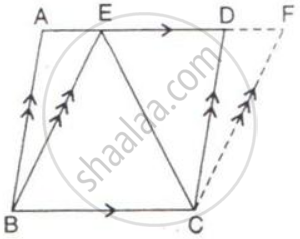
ABCD and BCFE are parallelograms. If area of triangle EBC = 480 cm2; AB = 30 cm and BC = 40 cm.
Calculate :
(i) Area of parallelogram ABCD;
(ii) Area of the parallelogram BCFE;
(iii) Length of altitude from A on CD;
(iv) Area of triangle ECF.
Advertisements
उत्तर
(i) Since ΔEBC and parallelogram ABCD are on the same base BC and between the same parallels i.e. BC // AD.
∴ A( ΔEBC ) = `1/2` x A( parallelogram ABCD )
parallelogram ABCD = 2 x A( ΔEBC )
= 2 x 480 cm2
= 960 cm2
(ii) Parallelograms on same base and between same parallels are equal in area.
Area of BCFE = Area of ABCD = 960 cm2
(iii) Area of triangle ACD=480 = `1/2` x 30 x Altitude
Altitude = 32 cm
(iv) The area of a triangle is half that of a parallelogram on the same base and between the same parallels.
Therefore,
Area( ΔECF ) = `1/2` Area(`square`CBEF )
Similarly, Area( ΔBCE ) = `1/2`Area(`square`CBEF )
⇒ Area( ΔECF ) = Area( ΔBCE ) = 480 cm2.
APPEARS IN
संबंधित प्रश्न
The given figure shows the parallelograms ABCD and APQR.
Show that these parallelograms are equal in the area.
[ Join B and R ]
The given figure shows a rectangle ABDC and a parallelogram ABEF; drawn on opposite sides of AB.
Prove that:
(i) Quadrilateral CDEF is a parallelogram;
(ii) Area of the quad. CDEF
= Area of rect. ABDC + Area of // gm. ABEF.
In the given figure, ABCD is a parallelogram; BC is produced to point X.
Prove that: area ( Δ ABX ) = area (`square`ACXD )
In the given figure, diagonals PR and QS of the parallelogram PQRS intersect at point O and LM is parallel to PS. Show that:
(i) 2 Area (POS) = Area (// gm PMLS)
(ii) Area (POS) + Area (QOR) = Area (// gm PQRS)
(iii) Area (POS) + Area (QOR) = Area (POQ) + Area (SOR).
In the given figure, M and N are the mid-points of the sides DC and AB respectively of the parallelogram ABCD.

If the area of parallelogram ABCD is 48 cm2;
(i) State the area of the triangle BEC.
(ii) Name the parallelogram which is equal in area to the triangle BEC.
In the given figure, AP is parallel to BC, BP is parallel to CQ.
Prove that the area of triangles ABC and BQP are equal.
ABCD is a parallelogram a line through A cuts DC at point P and BC produced at Q. Prove that triangle BCP is equal in area to triangle DPQ.

In a parallelogram ABCD, point P lies in DC such that DP: PC = 3:2. If the area of ΔDPB = 30 sq. cm.
find the area of the parallelogram ABCD.
In the given figure, the diagonals AC and BD intersect at point O. If OB = OD and AB//DC,
show that:
(i) Area (Δ DOC) = Area (Δ AOB).
(ii) Area (Δ DCB) = Area (Δ ACB).
(iii) ABCD is a parallelogram.

In parallelogram ABCD, E is a point in AB and DE meets diagonal AC at point F. If DF: FE = 5:3 and area of ΔADF is 60 cm2; find
(i) area of ΔADE.
(ii) if AE: EB = 4:5, find the area of ΔADB.
(iii) also, find the area of parallelogram ABCD.
