Advertisements
Advertisements
प्रश्न
In the following figure, DE is parallel to BC.
Show that:
(i) Area ( ΔADC ) = Area( ΔAEB ).
(ii) Area ( ΔBOD ) = Area( ΔCOE ).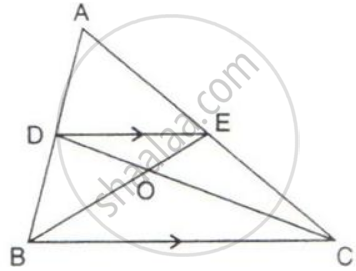
बेरीज
Advertisements
उत्तर
(i) In ΔABC, D is the midpoint of AB and E is the midpoint of AC.
`"AD"/"AB" = "AE"/"AC"`
DE is parallel to BC.
∴ A( ΔADC ) = A( ΔBDC ) = `1/2` A( ΔABC )
Again,
∴ A( ΔAEB ) = A( ΔBEC ) = `1/2` A( ΔABC )
From the above two equations, we have
Area( ΔADC ) = Area( ΔAEB ).
Hence Proved.
(ii) We know that the area of triangles on the same base and between the same parallel lines are equal.
Area( ΔDBC )= Area( ΔBCE )
Area( ΔDOB ) + Area( ΔBOC ) = Area( ΔBOC ) + Area( ΔCOE )
So, Area( ΔDOB ) = Area( ΔCOE ).
shaalaa.com
Figures Between the Same Parallels
या प्रश्नात किंवा उत्तरात काही त्रुटी आहे का?
