मराठी

In the Following, Ac // Ps // Qr and Pq // Db // Sr.Prove That: Area of Quadrilateral Pqrs = 2 X Area of the Quad. Abcd. - Mathematics

Advertisements
Advertisements

प्रश्न

In the following, AC // PS // QR and PQ // DB // SR.
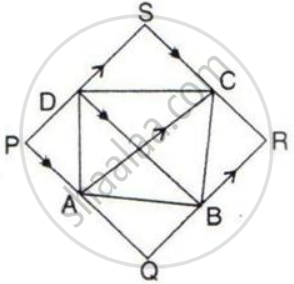
Prove that: Area of quadrilateral PQRS = 2 x Area of the quad. ABCD.

बेरीज
Advertisements

उत्तर

In Parallelogram PQRS,
AC // PS // QR and PQ // DB // SR.

Similarly, AQRC and APSC are also parallelograms.

Since ΔABC and parallelogram AQRC are on the same base AC and between the same parallels, then
A( ΔABC ) = `1/2`A(AQRC)  ......(i)

Similarly,
A( ΔADC ) = `1/2`A( APSC ) .......(ii)

Adding (i) and (ii), we get
Area of quadrilateral PQRS = 2 x Area of the quad. ABCD.

shaalaa.com
Figures Between the Same Parallels
  या प्रश्नात किंवा उत्तरात काही त्रुटी आहे का?
पाठ 16: Area Theorems [Proof and Use] - Exercise 16 (A) [पृष्ठ १९७]

APPEARS IN

सेलिना Concise Mathematics [English] Class 9 ICSE
पाठ 16 Area Theorems [Proof and Use]
Exercise 16 (A) | Q 14 | पृष्ठ १९७

संबंधित प्रश्‍न

In the given figure, AD // BE // CF.
Prove that area (ΔAEC) = area (ΔDBF)


ABCD is a trapezium with AB // DC. A line parallel to AC intersects AB at point M and BC at point N.
Prove that: area of Δ ADM = area of Δ ACN.


ABCD and BCFE are parallelograms. If area of triangle EBC = 480 cm2; AB = 30 cm and BC = 40 cm.

Calculate : 
(i) Area of parallelogram ABCD;
(ii) Area of the parallelogram BCFE;
(iii) Length of altitude from A on CD;
(iv) Area of triangle ECF.


In the given figure, diagonals PR and QS of the parallelogram PQRS intersect at point O and LM is parallel to PS. Show that:

(i) 2 Area (POS) = Area (// gm PMLS)
(ii) Area (POS) + Area (QOR) = Area (// gm PQRS)
(iii) Area (POS) + Area (QOR) = Area (POQ) + Area (SOR).


ABCD is a parallelogram a line through A cuts DC at point P and BC produced at Q. Prove that triangle BCP is equal in area to triangle DPQ.


Show that:

A diagonal divides a parallelogram into two triangles of equal area.


ABCD is a parallelogram in which BC is produced to E such that CE = BC and AE intersects CD at F.

If ar.(∆DFB) = 30 cm2; find the area of parallelogram.


In the given figure, the diagonals AC and BD intersect at point O. If OB = OD and AB//DC,
show that:
(i) Area (Δ DOC) = Area (Δ AOB).
(ii) Area (Δ DCB) = Area (Δ ACB).
(iii) ABCD is a parallelogram.


E, F, G, and H are the midpoints of the sides of a parallelogram ABCD.
Show that the area of quadrilateral EFGH is half of the area of parallelogram ABCD.


In the following figure, BD is parallel to CA, E is mid-point of CA and BD = `1/2`CA
Prove that: ar. ( ΔABC ) = 2 x ar.( ΔDBC )


Share
Notifications

Englishहिंदीमराठी


      Forgot password?
Use app×