मराठी

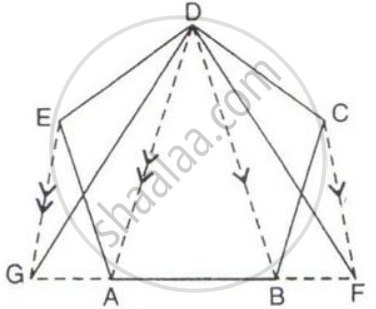
The given figure shows a pentagon ABCDE. EG drawn parallel to DA meets BA produced at G and CF draw parallel to DB meets AB produced at F.

Advertisements
Advertisements

प्रश्न

The given figure shows a pentagon ABCDE. EG drawn parallel to DA meets BA produced at G and CF draw parallel to DB meets AB produced at F.

Prove that the area of pentagon ABCDE is equal to the area of triangle GDF.
बेरीज
Advertisements

उत्तर
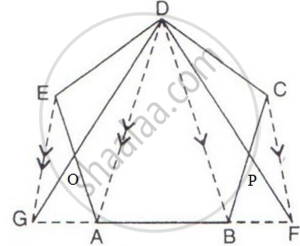

Since triangle EDG and EGA are on the same base EG and between the same parallel lines EG and DA.

Therefore,

A(ΔEDG) = A(ΔEGA)

Subtracting ΔEOG from both sides, we have

A(ΔEOD) = A(ΔGOA)              ...(i)

Similarly,

A(ΔDPC) = A(ΔBPF)              ...(ii)

Now

A(ΔGDF) = A(ΔGOA) + A(ΔBPF) + A(pen. ABPDO) 

= A(ΔEOD) + A(ΔDPC) + A(pen. ABPDO)

= A(pen. ABCDE)

Hence, proved.

shaalaa.com
Figures Between the Same Parallels
  या प्रश्नात किंवा उत्तरात काही त्रुटी आहे का?
पाठ 16: Area Theorems [Proof and Use] - Exercise 16 (A) [पृष्ठ १९७]

APPEARS IN

सेलिना Concise Mathematics [English] Class 9 ICSE
पाठ 16 Area Theorems [Proof and Use]
Exercise 16 (A) | Q 8 | पृष्ठ १९७

संबंधित प्रश्‍न

In the following, AC // PS // QR and PQ // DB // SR.

Prove that: Area of quadrilateral PQRS = 2 x Area of the quad. ABCD.


ABCD and BCFE are parallelograms. If area of triangle EBC = 480 cm2; AB = 30 cm and BC = 40 cm.

Calculate : 
(i) Area of parallelogram ABCD;
(ii) Area of the parallelogram BCFE;
(iii) Length of altitude from A on CD;
(iv) Area of triangle ECF.


In the given figure, diagonals PR and QS of the parallelogram PQRS intersect at point O and LM is parallel to PS. Show that:

(i) 2 Area (POS) = Area (// gm PMLS)
(ii) Area (POS) + Area (QOR) = Area (// gm PQRS)
(iii) Area (POS) + Area (QOR) = Area (POQ) + Area (SOR).


In the following figure, DE is parallel to BC.
Show that: 
(i) Area ( ΔADC ) = Area( ΔAEB ).
(ii) Area ( ΔBOD ) = Area( ΔCOE ).


In the following figure, CE is drawn parallel to diagonals DB of the quadrilateral ABCD which meets AB produced at point E.
Prove that ΔADE and quadrilateral ABCD are equal in area.


Show that:

A diagonal divides a parallelogram into two triangles of equal area.


In a parallelogram ABCD, point P lies in DC such that DP: PC = 3:2. If the area of ΔDPB = 30 sq. cm.
find the area of the parallelogram ABCD.


ABCD is a parallelogram. P and Q are the mid-points of sides AB and AD respectively.
Prove that area of triangle APQ = `1/8` of the area of parallelogram ABCD.


Show that:

The ratio of the areas of two triangles of the same height is equal to the ratio of their bases.


Show that:
The ratio of the areas of two triangles on the same base is equal to the ratio of their heights.


Share
Notifications

Englishहिंदीमराठी


      Forgot password?
Use app×