मराठी

Abcd is a Parallelogram a Line Through a Cuts Dc at Point P and Bc Produced at Q. Prove that Triangle Bcp is Equal in Area to Triangle Dpq - Mathematics

Advertisements
Advertisements

प्रश्न

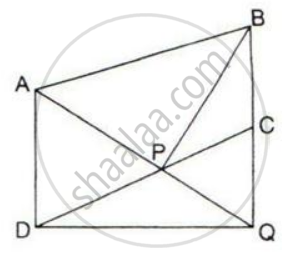
ABCD is a parallelogram a line through A cuts DC at point P and BC produced at Q. Prove that triangle BCP is equal in area to triangle DPQ.
बेरीज
Advertisements

उत्तर

ΔAPB and parallelogram ABCD are on the same base AB and between the same parallel lines AB and CD.

∴ Ar. ( ΔAPB ) = `1/2` Ar.( parallelogram ABCD ) ......(i)

ΔADQ and parallelogram ABCD are on the same base AD and between the same parallel lines AD and BQ.

∴ Ar.( ΔADQ ) = `1/2` Ar.( parallelogram ABCD ) ......(ii)

Adding equation (i) and (ii), we get

∴ Ar.( ΔAPB ) + Ar.( ΔADQ ) = Ar.(parallelogram ABCD)
Ar.( quad ADQB ) - Ar.(Δ BPQ ) = Ar.(parallelogram ABCD)
Ar.( quad ADQB) - Ar.( ΔBPQ ) = Ar.(quad ADQB ) -Ar.( ΔDCQ )
                            Ar. ( ΔBPQ ) = Ar. ( ΔDCQ )

Subtracting Ar.ΔPCQ from both sides, we get

Ar. ( ΔBPQ ) - Ar.(ΔPCQ ) = Ar. ( ΔDCQ ) - Ar. ( ΔPCQ)
                    Ar. ( ΔBCP ) = Ar. ( ΔDPQ )
Hence proved.

shaalaa.com
Figures Between the Same Parallels
  या प्रश्नात किंवा उत्तरात काही त्रुटी आहे का?
पाठ 16: Area Theorems [Proof and Use] - Exercise 16 (A) [पृष्ठ १९६]

APPEARS IN

सेलिना Concise Mathematics [English] Class 9 ICSE
पाठ 16 Area Theorems [Proof and Use]
Exercise 16 (A) | Q 7 | पृष्ठ १९६

संबंधित प्रश्‍न

The given figure shows a rectangle ABDC and a parallelogram ABEF; drawn on opposite sides of AB.
Prove that: 
(i) Quadrilateral CDEF is a parallelogram;
(ii) Area of the quad. CDEF
= Area of rect. ABDC + Area of // gm. ABEF.


In the given figure, diagonals PR and QS of the parallelogram PQRS intersect at point O and LM is parallel to PS. Show that:

(i) 2 Area (POS) = Area (// gm PMLS)
(ii) Area (POS) + Area (QOR) = Area (// gm PQRS)
(iii) Area (POS) + Area (QOR) = Area (POQ) + Area (SOR).


In the following figure, DE is parallel to BC.
Show that: 
(i) Area ( ΔADC ) = Area( ΔAEB ).
(ii) Area ( ΔBOD ) = Area( ΔCOE ).


In the following figure, CE is drawn parallel to diagonals DB of the quadrilateral ABCD which meets AB produced at point E.
Prove that ΔADE and quadrilateral ABCD are equal in area.


In the figure given alongside, squares ABDE and AFGC are drawn on the side AB and the hypotenuse AC of the right triangle ABC.

If BH is perpendicular to FG

prove that:

  1. ΔEAC ≅ ΔBAF
  2. Area of the square ABDE
  3. Area of the rectangle ARHF.

Show that:

A diagonal divides a parallelogram into two triangles of equal area.


In the following figure, BD is parallel to CA, E is mid-point of CA and BD = `1/2`CA
Prove that: ar. ( ΔABC ) = 2 x ar.( ΔDBC )


In parallelogram ABCD, E is a point in AB and DE meets diagonal AC at point F. If DF: FE = 5:3 and area of  ΔADF is 60 cm2; find
(i) area of ΔADE.
(ii) if AE: EB = 4:5, find the area of  ΔADB.
(iii) also, find the area of parallelogram ABCD.


In ΔABC, E and F are mid-points of sides AB and AC respectively. If BF and CE intersect each other at point O,
prove that the ΔOBC and quadrilateral AEOF are equal in area.


In parallelogram ABCD, P is the mid-point of AB. CP and BD intersect each other at point O. If the area of ΔPOB = 40 cm2, and OP: OC = 1:2, find:
(i) Areas of ΔBOC and ΔPBC
(ii) Areas of ΔABC and parallelogram ABCD.


Share
Notifications

Englishहिंदीमराठी


      Forgot password?
Use app×