Advertisements
Advertisements
Question
In the given figure, diagonals PR and QS of the parallelogram PQRS intersect at point O and LM is parallel to PS. Show that:
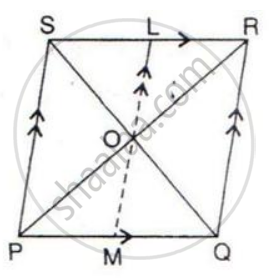
(i) 2 Area (POS) = Area (// gm PMLS)
(ii) Area (POS) + Area (QOR) = Area (// gm PQRS)
(iii) Area (POS) + Area (QOR) = Area (POQ) + Area (SOR).
Advertisements
Solution
(i) Since POS and parallelogram, PMLS are on the same base PS and between the same parallels i.e. SP//LM.
As O is the center of LM and the Ratio of the area of triangles with the same vertex and bases along the same line is equal to the ratio of their respective bases.
The area of the parallelogram is twice the area of the triangle if they lie on the same base and in between the same parallels.
So 2(Area of PSO)=Area of PMLS
Hence Proved.
(ii) Consider the expression: Area ( ΔPOS) + Area ( QOR ):
LM is parallel to PS and PS is parallel to RQ, therefore, LM is
Since triangle POS lie on the base PS and in between the parallels PS and LM, we have,
Area ( ΔPOS ) = `1/2"Area"( square` PSLM )
Since triangle QOR lie on the base QR and in between the Parallels LM and RQ, we have,
Area ( ΔQOR ) = `1/2"Area" ( square` LMQR )
Area ( ΔPOS ) + Area ( ΔQOR ) = `1/2"Area"( square` PSLM ) + `1/2"Area"( square` LMQR )
= `1/2 ["Area (PSLM )" + "Area" ( square` LMQR )]
= `1/2["Area" ( square` PQRS) ]
(iii) In a parallelogram, the diagonals bisect each other.
Therefore, OS = OQ
Consider the triangle PQS, since OS = OQ, OP is the median of the triangle PQS.
We know that the median of a triangle divides it into two triangles of equal area.
Therefore,
Area ( ΔPOS) = Area ( ΔPOQ ) ....(1)
Similarly, since OR is the median of the triangle QRS, we have, Area ( ΔQOR ) = Area ( ΔSOR ) ....(2)
Adding equations (1) and (2), we have,
Area ( ΔPOS ) + Area( ΔQOR) = Area ( ΔPOQ ) + Area( SOR)
Hence Proved.
APPEARS IN
RELATED QUESTIONS
The given figure shows a rectangle ABDC and a parallelogram ABEF; drawn on opposite sides of AB.
Prove that:
(i) Quadrilateral CDEF is a parallelogram;
(ii) Area of the quad. CDEF
= Area of rect. ABDC + Area of // gm. ABEF.
ABCD and BCFE are parallelograms. If area of triangle EBC = 480 cm2; AB = 30 cm and BC = 40 cm.
Calculate :
(i) Area of parallelogram ABCD;
(ii) Area of the parallelogram BCFE;
(iii) Length of altitude from A on CD;
(iv) Area of triangle ECF.
In the following figure, DE is parallel to BC.
Show that:
(i) Area ( ΔADC ) = Area( ΔAEB ).
(ii) Area ( ΔBOD ) = Area( ΔCOE ).
In the given figure, M and N are the mid-points of the sides DC and AB respectively of the parallelogram ABCD.

If the area of parallelogram ABCD is 48 cm2;
(i) State the area of the triangle BEC.
(ii) Name the parallelogram which is equal in area to the triangle BEC.
In the following figure, CE is drawn parallel to diagonals DB of the quadrilateral ABCD which meets AB produced at point E.
Prove that ΔADE and quadrilateral ABCD are equal in area.
In the figure given alongside, squares ABDE and AFGC are drawn on the side AB and the hypotenuse AC of the right triangle ABC.

If BH is perpendicular to FG
prove that:
- ΔEAC ≅ ΔBAF
- Area of the square ABDE
- Area of the rectangle ARHF.
In the given figure, AP is parallel to BC, BP is parallel to CQ.
Prove that the area of triangles ABC and BQP are equal.
ABCD is a parallelogram a line through A cuts DC at point P and BC produced at Q. Prove that triangle BCP is equal in area to triangle DPQ.

In the given figure, the diagonals AC and BD intersect at point O. If OB = OD and AB//DC,
show that:
(i) Area (Δ DOC) = Area (Δ AOB).
(ii) Area (Δ DCB) = Area (Δ ACB).
(iii) ABCD is a parallelogram.

In ΔABC, E and F are mid-points of sides AB and AC respectively. If BF and CE intersect each other at point O,
prove that the ΔOBC and quadrilateral AEOF are equal in area.
