Advertisements
Advertisements
Question
E, F, G, and H are the midpoints of the sides of a parallelogram ABCD.
Show that the area of quadrilateral EFGH is half of the area of parallelogram ABCD.
Advertisements
Solution
Join HF.
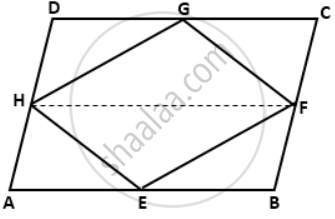
Since H and F are mid-points of AD and BC respectively,
∴ AH = `1/2 "AD and BF" = 1/2 "BC"`
Now, ABCD is a parallelogram.
⇒ AD = BC and AD ∥ BC
⇒ `1/2 "AD" = 1/2`BC and AD || BC
⇒ AH = BF and AH ∥ BF
⇒ ABFH is a parallelogram.
Since parallelogram FHAB and ΔFHE are on the same base FH and between the same parallels HF and AB,
A( ΔFHE ) = `1/2`A ( ||m FHAB ) .....(i)
Similarly,
A( ΔFHG ) = `1/2`A ( ||m FHDC ) .......(ii)
Adding (i) and (ii), We get,
A( ΔFHE ) + A( ΔFHG ) = `1/2 "A"( ||^m "FHAB" ) + 1/2`A ( ||m FHDC )
⇒ A( EFGH ) = `1/2`[ A ( ||m FHAB ) + A ( ||m FHDC ) ]
⇒ A( EFGH ) = `1/2`A( ||m ABCD )
APPEARS IN
RELATED QUESTIONS
In the given figure, if the area of triangle ADE is 60 cm2, state, given reason, the area of :
(i) Parallelogram ABED;
(ii) Rectangle ABCF;
(iii) Triangle ABE.
The given figure shows the parallelograms ABCD and APQR.
Show that these parallelograms are equal in the area.
[ Join B and R ]
In the following, AC // PS // QR and PQ // DB // SR.
Prove that: Area of quadrilateral PQRS = 2 x Area of the quad. ABCD.
In parallelogram ABCD, P is a point on side AB and Q is a point on side BC.
Prove that:
(i) ΔCPD and ΔAQD are equal in the area.
(ii) Area (ΔAQD) = Area (ΔAPD) + Area (ΔCPB)
In the following figure, DE is parallel to BC.
Show that:
(i) Area ( ΔADC ) = Area( ΔAEB ).
(ii) Area ( ΔBOD ) = Area( ΔCOE ).
Show that:
A diagonal divides a parallelogram into two triangles of equal area.
ABCD is a parallelogram in which BC is produced to E such that CE = BC and AE intersects CD at F.
If ar.(∆DFB) = 30 cm2; find the area of parallelogram.
ABCD is a parallelogram. P and Q are the mid-points of sides AB and AD respectively.
Prove that area of triangle APQ = `1/8` of the area of parallelogram ABCD.
ABCD is a trapezium with AB parallel to DC. A line parallel to AC intersects AB at X and BC at Y.
Prove that the area of ∆ADX = area of ∆ACY.
Show that:
The ratio of the areas of two triangles of the same height is equal to the ratio of their bases.
