Advertisements
Advertisements
प्रश्न
E, F, G, and H are the midpoints of the sides of a parallelogram ABCD.
Show that the area of quadrilateral EFGH is half of the area of parallelogram ABCD.
Advertisements
उत्तर
Join HF.
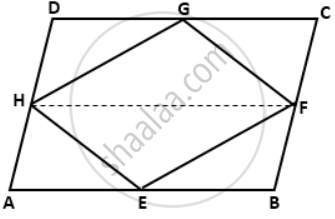
Since H and F are mid-points of AD and BC respectively,
∴ AH = `1/2 "AD and BF" = 1/2 "BC"`
Now, ABCD is a parallelogram.
⇒ AD = BC and AD ∥ BC
⇒ `1/2 "AD" = 1/2`BC and AD || BC
⇒ AH = BF and AH ∥ BF
⇒ ABFH is a parallelogram.
Since parallelogram FHAB and ΔFHE are on the same base FH and between the same parallels HF and AB,
A( ΔFHE ) = `1/2`A ( ||m FHAB ) .....(i)
Similarly,
A( ΔFHG ) = `1/2`A ( ||m FHDC ) .......(ii)
Adding (i) and (ii), We get,
A( ΔFHE ) + A( ΔFHG ) = `1/2 "A"( ||^m "FHAB" ) + 1/2`A ( ||m FHDC )
⇒ A( EFGH ) = `1/2`[ A ( ||m FHAB ) + A ( ||m FHDC ) ]
⇒ A( EFGH ) = `1/2`A( ||m ABCD )
APPEARS IN
संबंधित प्रश्न
In the given figure, if the area of triangle ADE is 60 cm2, state, given reason, the area of :
(i) Parallelogram ABED;
(ii) Rectangle ABCF;
(iii) Triangle ABE.
The given figure shows a rectangle ABDC and a parallelogram ABEF; drawn on opposite sides of AB.
Prove that:
(i) Quadrilateral CDEF is a parallelogram;
(ii) Area of the quad. CDEF
= Area of rect. ABDC + Area of // gm. ABEF.
In the following, AC // PS // QR and PQ // DB // SR.
Prove that: Area of quadrilateral PQRS = 2 x Area of the quad. ABCD.
In the following figure, CE is drawn parallel to diagonals DB of the quadrilateral ABCD which meets AB produced at point E.
Prove that ΔADE and quadrilateral ABCD are equal in area.
In the figure given alongside, squares ABDE and AFGC are drawn on the side AB and the hypotenuse AC of the right triangle ABC.

If BH is perpendicular to FG
prove that:
- ΔEAC ≅ ΔBAF
- Area of the square ABDE
- Area of the rectangle ARHF.
In the given figure, AP is parallel to BC, BP is parallel to CQ.
Prove that the area of triangles ABC and BQP are equal.
The given figure shows a pentagon ABCDE. EG drawn parallel to DA meets BA produced at G and CF draw parallel to DB meets AB produced at F.
Prove that the area of pentagon ABCDE is equal to the area of triangle GDF.

Show that:
A diagonal divides a parallelogram into two triangles of equal area.
The given figure shows a parallelogram ABCD with area 324 sq. cm. P is a point in AB such that AP: PB = 1:2
Find The area of Δ APD.
In parallelogram ABCD, E is a point in AB and DE meets diagonal AC at point F. If DF: FE = 5:3 and area of ΔADF is 60 cm2; find
(i) area of ΔADE.
(ii) if AE: EB = 4:5, find the area of ΔADB.
(iii) also, find the area of parallelogram ABCD.
