Advertisements
Advertisements
प्रश्न
In the given figure, diagonals PR and QS of the parallelogram PQRS intersect at point O and LM is parallel to PS. Show that: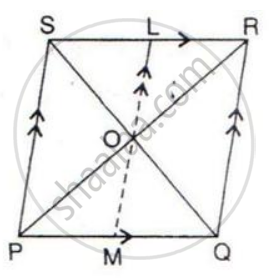
(i) 2 Area (POS) = Area (// gm PMLS)
(ii) Area (POS) + Area (QOR) = Area (// gm PQRS)
(iii) Area (POS) + Area (QOR) = Area (POQ) + Area (SOR).
Advertisements
उत्तर
(i) Since POS and parallelogram, PMLS are on the same base PS and between the same parallels i.e. SP//LM.
As O is the center of LM and the Ratio of the area of triangles with the same vertex and bases along the same line is equal to the ratio of their respective bases.
The area of the parallelogram is twice the area of the triangle if they lie on the same base and in between the same parallels.
So 2(Area of PSO)=Area of PMLS
Hence Proved.
(ii) Consider the expression: Area ( ΔPOS) + Area ( QOR ):
LM is parallel to PS and PS is parallel to RQ, therefore, LM is
Since triangle POS lie on the base PS and in between the parallels PS and LM, we have,
Area ( ΔPOS ) = `1/2"Area"( square` PSLM )
Since triangle QOR lie on the base QR and in between the Parallels LM and RQ, we have,
Area ( ΔQOR ) = `1/2"Area" ( square` LMQR )
Area ( ΔPOS ) + Area ( ΔQOR ) = `1/2"Area"( square` PSLM ) + `1/2"Area"( square` LMQR )
= `1/2 ["Area (PSLM )" + "Area" ( square` LMQR )]
= `1/2["Area" ( square` PQRS) ]
(iii) In a parallelogram, the diagonals bisect each other.
Therefore, OS = OQ
Consider the triangle PQS, since OS = OQ, OP is the median of the triangle PQS.
We know that the median of a triangle divides it into two triangles of equal area.
Therefore,
Area ( ΔPOS) = Area ( ΔPOQ ) ....(1)
Similarly, since OR is the median of the triangle QRS, we have, Area ( ΔQOR ) = Area ( ΔSOR ) ....(2)
Adding equations (1) and (2), we have,
Area ( ΔPOS ) + Area( ΔQOR) = Area ( ΔPOQ ) + Area( SOR)
Hence Proved.
