हिंदी

The Given Figure Shows a Rectangle Abdc and a Parallelogram Abef; Drawn on Opposite Sides of Ab. Prove That: Quadrilateral Cdef is a Parallelogram Area of Quad. Cdef = Area of Rect. Abdc

Advertisements
Advertisements

प्रश्न

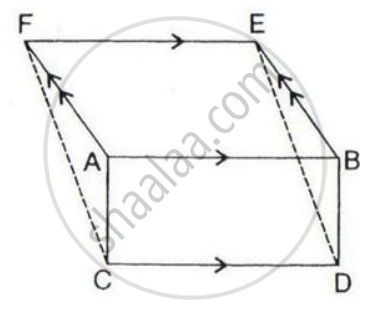
The given figure shows a rectangle ABDC and a parallelogram ABEF; drawn on opposite sides of AB.
Prove that: 
(i) Quadrilateral CDEF is a parallelogram;
(ii) Area of the quad. CDEF
= Area of rect. ABDC + Area of // gm. ABEF.
योग
Advertisements

उत्तर

After drawing the opposite sides of AB, we get

Since from the figure, we get CD//FE, therefore, FC must parallel to DE. Therefore it is proved that the quadrilateral CDEF is a parallelogram.

The area of the parallelogram on the same base and between the same parallel lines is always equal and the area of the parallelogram is equal to the area of a rectangle on the same base and of the same altitude i.e, between the same parallel lines. 

So Area of CDEF= Area of ABDC + Area of ABEF 
Hence Proved

shaalaa.com
Figures Between the Same Parallels
  क्या इस प्रश्न या उत्तर में कोई त्रुटि है?
अध्याय 15: Area Theorems [Proof and Use] - Exercise 16 (A) [पृष्ठ १९६]

APPEARS IN

सेलिना Concise Mathematics [English] Class 9 ICSE
अध्याय 15 Area Theorems [Proof and Use]
Exercise 16 (A) | Q 2 | पृष्ठ १९६

संबंधित प्रश्न

In the given figure, if the area of triangle ADE is 60 cm2, state, given reason, the area of :
(i) Parallelogram ABED;
(ii) Rectangle ABCF;
(iii) Triangle ABE.


In the given figure, ABCD is a parallelogram; BC is produced to point X.
Prove that: area ( Δ ABX ) = area (`square`ACXD )


ABCD is a trapezium with AB // DC. A line parallel to AC intersects AB at point M and BC at point N.
Prove that: area of Δ ADM = area of Δ ACN.


In the given figure, D is mid-point of side AB of ΔABC and BDEC is a parallelogram.

Prove that: Area of ABC = Area of // gm BDEC.


In the following figure, DE is parallel to BC.
Show that: 
(i) Area ( ΔADC ) = Area( ΔAEB ).
(ii) Area ( ΔBOD ) = Area( ΔCOE ).


In the given figure, M and N are the mid-points of the sides DC and AB respectively of the parallelogram ABCD.

If the area of parallelogram ABCD is 48 cm2;
(i) State the area of the triangle BEC.
(ii) Name the parallelogram which is equal in area to the triangle BEC.


ABCD is a parallelogram a line through A cuts DC at point P and BC produced at Q. Prove that triangle BCP is equal in area to triangle DPQ.


ABCD is a parallelogram. P and Q are the mid-points of sides AB and AD respectively.
Prove that area of triangle APQ = `1/8` of the area of parallelogram ABCD.


In parallelogram ABCD, E is a point in AB and DE meets diagonal AC at point F. If DF: FE = 5:3 and area of  ΔADF is 60 cm2; find
(i) area of ΔADE.
(ii) if AE: EB = 4:5, find the area of  ΔADB.
(iii) also, find the area of parallelogram ABCD.


In parallelogram ABCD, P is the mid-point of AB. CP and BD intersect each other at point O. If the area of ΔPOB = 40 cm2, and OP: OC = 1:2, find:
(i) Areas of ΔBOC and ΔPBC
(ii) Areas of ΔABC and parallelogram ABCD.


Share
Notifications

Englishहिंदीमराठी


      Forgot password?
Use app×