Sarita Aggarwal solutions for Biology [English] Class 12 ISC chapter 5 - Principles of Inheritance and Variation [Latest edition]
Chapters
1: Reproduction in Organisms
2: Sexual Reproduction in Flowering Plants
3: Human Reproduction
4: Reproductive Health-Problems and Strategies
Unit 2 – Genetics and Evolution
▶ 5: Principles of Inheritance and Variation
6: Chromosomes, Sex-Linked Inheritance and Human Genetic Disorders
7: Molecular Basis of Inheritance
8: Evolution-Origin of Life
9: Theory of Evolution and Evolution of Man
Unit 3 – Biology and Human Welfare
10: Human Health and Diseases
11: Adolescent Issues: Alcoholism and Drugs
12: Animal Breeding for Improvement in Food Production
13: Plant Breeding to Enhance Food Production
14: Microbes in Human Welfare
Unit 4 – Biotechnology
15: Biotechnology: Principles and Processes
16: Biotechnology and Its Applications
Unit 5 – Ecology and Environment
17: Organisms and Populations
18: Ecosystem
19: Biodiversity and Conservation
20: Environmental Issues
Advertisements
Advertisements
Solutions for Chapter 5: Principles of Inheritance and Variation
Below listed, you can find solutions for Chapter 5 of CISCE Sarita Aggarwal for Biology [English] Class 12 ISC.
Advertisements
Sarita Aggarwal solutions for Biology [English] Class 12 ISC 5 Principles of Inheritance and Variation EXERCISES [Pages 250 - 265]
A. OBJECTIVE QUESTIONS Multiple choice questions Choose the correct answer:
In a pea plant the gene T for tallness is dominant over the gene t for dwarfness. If two heterozygous individuals are crossed ______.
the phenotypic and the genotypic ratio will be the same.
the genotypic ratio would be (3 : 1)
the phenotypic ratio would be 3 dwarf : 1 tall
(25%) individuals would be dwarf
When a hybrid of F1 is crossed with the homozygous recessive parent, it is called ______.
monohybrid cross
dihybrid cross
test cross
none of the above
When Aa hybrid is crossed back with the homozygous dominant parent, the phenotypic ratio of the progeny will be ______.
3 : 1
1 : 2 : 1
all would resemble the dominant parent
2 hybrid : 2 recessive
Which of the following terms represent a pair of contrasting characters?
allelomorphs
homozygous
heterozygous
coccus
When two organisms are similar in their external form but differ in their genetic make-up, they are referred as ______.
genotype
phenotype
homozygous
heterozygous
A character that appears in the homozygous condition only is called ______.
heterozygous
phenotype
recessive
heterozygous
A typical F2 1 : 2 : 1 phenotypic ratio in a monohybrid cross is characteristic of ______.
incomplete dominance
co-dominance
law of dominance
dominant
Blood groups in humans is an example of ______.
incomplete dominance
co-dominance
quantitative inheritance
pleiotropy
Complementary genes give a characteristic ratio of ______.
9 : 3 : 3 : 1
9 : 3 : 4
9 : 7
15 : 1
Agene that has many phenotypic effects is called ______.
complementary gene
supplementary gene
cumulative gene
pleiotropic gene
How many kinds of gametes are possible with the genotype AaBB?
AB and aB
Aa and BB
A, a, B and B
AB, Aa, BB and aB
What is the probability of getting the gamete ab from the genotype Aabb?
25%
50%
75%
100%
If all the offspring have the genotype Aa, most probably the parental genotypes could bе ______.
Aa and Aa
AA and aa
aa and Aa
AA and Aa
An individual with unknown genotype is crossed with homozygous recessive for the trait, all the offsprings produced showed the dominant phenotype. The unknown genotype would be ______.
AA
Aa
aa
AB
A gamete contains ______.
both alleles of a gene
only one allele of a gene
all alleles of a gene
many alleles of a gene
If tall (T) is dominant over dwarf (t) and round seeds (R) is dominant over wrinkled seeds (r), the genotype of a true breeding tall plant with wrinkled seeds would be ______.
TtRr
TTRR
TTrr
TTRr
In the example given above if the genotype is ttRr the phenotype would be ______.
tall and wrinkled
dwarf and wrinkled
dwarf and round
tall and round
A typical phenotypic monohybrid ratio of F2 in Mendel's experiment is ______.
1 : 2 : 1
3 : 1
1 : 3 : 1
9 : 3 : 3 : 1
If a pure tall plant is crossed with а dwarf plant, the offspring will be ______.
all tall
all dwarf
(50%) tall and (50%) dwarf
3 : 1
A plant with yellow pods and wrinkled seeds with genotype Yy rr will give rise to following types of gametes.
Yy and rr
Yr and rr
Yr and yr
Yy and yr
Which one of the following represents a quantitative ratio?
9 : 3 : 3 : 1
1 : 4 : 6 : 4 : 1
9 : 3 : 4
1 : 2 : 3 : 4
If the offsprings have the blood groups O and A the genotype of parents would be ______.
IAIA and IAi
IAi and ii
IAIA and IAIA
IAi and IBi
In the dihybrid ratio, the homozygous dominant individuals represent ______.
1/16th of the total
9/16th of the total
1/8th of the total
3/16th of the total
How many types of gametes are found in F1 progeny of cross AA BB CC and aa bb cc?
3
8
27
64
A person with blood group A possesses ______.
antigen a and antibody b
antigen b and antibody a
antigen a and antibody b
no antigen and no antibody
9 : 3 : 3 : 1 ratio is due to ______.
Segregation
Crossing over
Independent assortment
Recessiveness
homologous pairing
Test cross is crossing between ______.
genotype with dominant trait
genotype with recessive trait
F1 hybrid with double recessive
two F1 hybrids
A test cross is ______.
Ww × ww
WW × Ww
Ww × Ww
ww × ww
Grain colour of wheat is determined by three pairs of polygenes. In cross AABBCC×aabbcc, progeny resembling either parent in F2 generation is ______.
half
one third
less than 5%
75%
In a plant, red fruit (R) is dominant over yellow fruit (r) and tallness (T) is dominant over dwarfness (t). If a plant with RRTt genotype is crossed with a plant that is rrtt ______.
50% will be tall with red fruit
75% will be tall with red fruit
all the offspring will be tall with red fruit
25% will be tall with red fruit
In pea plants, yellow seeds are dominant to green. If a heterozygous yellow seed pant is crossed with a green seeded plant, what ratio of yellow and green seeded plants would you expect in the F1 generation?
9:1
1:3
3:1
50:50
When a tall plant with round seeds (TTRR) crossed with a dwarf plant with wrinkle seeds (ttrr). What would be the proportion of dwarf plant with wrinkled seeds in F1 generation?
`1/4`
`1/16`
0
`1/4`
Genotype of hybrid is determined by ______.
crossing it with recessive parent
crossing it with another F₁ progeny
crossing it with female parent
crossing it with male parent
What would be blood groups of the progeny of heterozygous father with blood group A and mother homozygous for B?
A and B
AB and A
O
AB and B
In F2 generation of quantitative inheritance, a ratio of 1 : 4 : 6 : 4 : 1 is obtained instead of ______.
7 : 4 : 1 : 4
3 : 1
9 : 3 : 3 : 1
8 : 6 : 4 : 1
In a monohybrid cross involving incomplete dominance the phenotypic ratio equals the genotypic ratio if F2 generation. The ratio is ______.
3 : 1
1 : 2 : 1
1 : 1 : 1 : 1
9 : 7
II. Fill in the blanks
A cross where the inheritance of pair of character studied is called ______.
The genetic expression of a gene is called ______.
The physical expression of a gene is called ______.
Scientific name of the plant chosen by Mendel for his experiments is ______.
The phenotypic ratio of F2 generation in monohybrid cross is ______.
______ is made to determine the unknown genotype within one breeding experiment.
ABO blood group is an example of codominance as well as ______.
______ are different forms of genes.
______ gene has many effects on the phenotype.
State whether the following is true or false.
Each gamete has only one allele of a gene.
State whether the following is true or false.
A typical Mendelian dihybrid ratio of F2 generation is 3:1.
State whether the following is true or false.
A recessive factor is altered by the presence of a dominant factor.
State whether the following is true or false.
Blood groups in humans is an example of codominance.
State whether the following is true or false.
Hybrid is an offspring from a cross between genetically different parents.
State whether the following is true or false.
Phenylketonuria exhibits itself in the homozygous recessive condition.
State whether the following is true or false.
Incomplete dominance is shown in the flower colour of Mirabilis jalaра.
Match the following.
| Column A | Column B |
|---|---|
| 1. Incomplete dominance | (a) F1 offsprings are intermediate between both parental traits |
| 2. Pleiotropy | (b) ABO blood group system in humans |
| 3. Co-dominance | (c) Skin colour in humans |
| 4. Dihybrid cross | (d) Phenylketonuria |
| 5. Polygenic inheritance | (e) Law of independent assortment |
Answer the following in one or two words.
A condition where an organism has different allelic forms of a gene.
Answer the following in one or two words.
Physical expression of gene.
Answer the following in one or two words.
Alternate or different forms of a gene.
Give One Word Answer.
An allele that does not express when present along with a dominant allele.
Answer the following in one or two words.
A cross between an unknown genotype and homozygous recessive of same trait.
In the questions given below, there are two statements marked as Assertion (A) and Reason (R). Read the statements and choose the correct option.
Assertion (A): In a monohybrid cross, at F2 stage, both parental traits are expressed in the proportion of 3 : 1.
Reason (R): At F1 stage, the contrasting parental traits show blending but at F2 stage there is no blending.
Both assertion (A) and reason (R) are true, and reason is the correct explanation of assertion.
Both assertion (A) and reason (R) are true, but reason is not the correct explanation of assertion.
Assertion (A) is true but reason (R) is false.
Both assertion (A) and reason (R) are false.
Assertion (A): ABO blood grouping is a good example of multiple alleles.
Reason (R): When IA and IB alleles are present together in blood group, they both express their own types.
Both assertion (A) and reason (R) are true, and reason is the correct explanation of assertion.
Both assertion (A) and reason (R) are true, but reason is not the correct explanation of assertion.
Assertion (A) is true but reason (R) is false.
Both assertion (A) and reason (R) are false.
Assertion (A): In Mirabilis jalapa, selfing of F1 pink flowers produces same phenotypic and genotypic ratio.
Reason (R): Flower colour gene shows incomplete dominance.
Both assertion (A) and reason (R) are true, and reason is the correct explanation of assertion.
Both assertion (A) and reason (R) are true, but reason is not the correct explanation of assertion.
Assertion (A) is true but reason (R) is false.
Both assertion (A) and reason (R) are false.
Assertion (A): Phenylketonuria is a recessive hereditary disorder which leads to accumulation of phenyl pyruvic acid and other derivatives in the brain.
Reason (R): The affected individual lacks an enzyme that converts amino acid phenylalanine into tyrosine.
Both assertion (A) and reason (R) are true, and reason is the correct explanation of assertion.
Both assertion (A) and reason (R) are true, but reason is not the correct explanation of assertion.
Assertion (A) is true but reason (R) is false.
Both assertion (A) and reason (R) are false.
Read the sources given and answer any four from the questions given below:
| In human beings, the ABO blood group system is an example of multiple alleles. The inheritance of blood groups is based on three alleles namely IA, IB and i. Of these IA and IB are dominant and i is recessive. Allele IA is responsible for the presence of type A antigen while allele IB is responsible for type B antigen on the RBC. Allele i is recessive and does not produce any antigen. Out of these three alleles, only two alleles can be present at a time in any human being. Various combinations of allelic pairs result in four types of human blood groups namely A, B, AB and O. Person with blood group A can have genotype IA IA or IA i, blood group B can have genotypes IB IB or IB i and blood group AB has genotype IA IB. Blood group O has genotype ii. The pattern of inheritance follows Mendel's laws of inheritance. ABO blood group in humans is also an example of co-dominance. Co-dominance means both the alleles are equally dominant and hence both express themselves equally in the phenotype. This is the reason why a person that has both alleles IA and IB has the blood group AB as it has both the antigens A as well as B in its blood. |
- The blood group of a person is determined by the following number of alleles present in him or her
- two
- three
- four
- many
- A person with blood group O has
- two dominant alleles
- two recessive alleles
- one dominant and one recessive allele
- two recessive antigens
- Which of the following statements is true for co-dominance?
- When both alleles are present, both express and an intermediate type is formed
- One allele is partially dominant over another and so shows a partial effect
- Both alleles are equally dominant and express equally
- Both (a) and (b)
- Study the pedigree chart showing the pattern of inheritance of blood group in a family and answer the questions that follow.
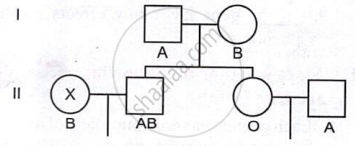
The genotypes of the parents in generation I are
- IAi and IB i
- IA i and IB IB
- IA i and IB IB
- IA IA and IB i
- From the pedigree chart given in part 4, the genotype of 'X' in generation II is
- IBI
- IB IB
- IA IB
- i i
B. SUBJECTIVE QUESTIONS Very short answer type questions (1 mark)
Give scientific name of the plant Mendel chose for his experiments.
How do the flowers get pollinated in graden pea?
According is Mendel, how many factors does a gamete possess?
Name the condition when both the alleles are identical in an organism.
Name the cross between two pairs of contrasting characters called?
What will be the genotype of a tall plant which on self-crossing gives rise to a few dwarf plants also?
According to Mendel, how many factors for each character are present in an offspring?
What are Mendel's factors known as by the scientists today?
How did Mendel make sure that he gets true-breeding or pure-breeding forms?
How did Mendel pollinate his flowers:
At the start of his experiment
How did Mendel pollinate his flowers:
Flowers of F1 generation
If Mendel crossed tall and dwarf plants, what kind of plants did he get in F1 and F2 and in which ratio?
If a plant of violet colour (C) is dominant over white (c), then give the possible genotypes of violet colour plants?
To know the genotype of a dominant phenotype, what kind of cross is done?
In a dihybrid cross between round and green seed variety with wrinkled and yellow seed variety, F2 generation shows 9 : 3 : 3 : 1. In this ratio what kind of phenotypes are represented by 9 and 3?
In snapdragon, if white flower variety is crossed with red variety, what is the genotype and phenotype of F1 generation, if red is represented by R and white by r?
If IA represents A allele and IB as B allele and i third allele in blood groups, what will be the genotypes of A blood group and O blood group?
Which allele of IA and IB in blood groups is dominant?
If the genotype is IAIB, what will be the type of blood group and why?
In Lathyrus odoratus, what does the F1 ratio of 9 : 7 represent in phenotypes in flower colours.
What kind of inheritance is skin colour in humans?
Name the cross in which inheritance of two pairs of contrasting characters are studied.
Name the condition when both the alleles are identical in an organism.
Name some other effects it causes in the body.
What will be the genotype of a tall plant which on self-crossing gives rise to a few dwarf plants also?
Short answer type questions (2 marks)
Name of the plant chosen by Mendel for his experiment.
Name any two pairs of contrasting traits studied by Mendel.
Name the condition when both the alleles are identical in an organism.
What is a cross between two pairs of contrasting characters called?
What will be the genotype of a tall plant which on self-crossing gives rise to a few dwarf plants also?
Why does skin colour show a continuous variation?
How many types of gametes are formed by a heterozygous dihybrid?
How did Mendel make sure that the plants were true breeding?
What will happen in a test cross, if the unknown genotype is crossed with the homozygous dominant allele?
How is the inheritance of flower colour in garden pea is different from the flower colour of snapdragron?
Why does skin colour show a continuous variation?
How many types of gametes are formed by a heterozygous dihybrid?
List two situations when independent assortment of genes occurs.
How does pedigree analysis of a population helps?
Short answer type questions (3 marks)
Give genotypes and phenotypes of a cross between a pure tall plant and a heterozygous tall plant. Explain it with reference to Mendel's law of inheritance.
Explain the inheritance of flower colour in four O'clock plant. How is it different from flower colour in garden pea?
If two heterozygotes are crossed, what kind of phenotypic ratio would be obtained for dominant and recessive traits. Show the cross by a Punnett square. Is it different from genotypic ratio? Explain.
What are pleiotropic genes? Explain it with the help of an example.
What is the significance of pedigree analysis for the geneticist? Give one example where it can be been used for genetic counselling.
How is the skin colour in man inherited? Is it different from inheritance of eye colour? Explain.
A man with blood group A married a woman with blood group B. They have a son with AB blood group and a daughter with blood group O. Work out the cross and show the possibility of such inheritance.
You are given tall pea plants with yellow seeds whose genotypes are unknown. How would you find the genotype of these plants? Explain with the help of a cross.
Give the genotype and phenotype of the plants of F1 generation. Mention the possible combinations of the gametes that can be obtained from the F1 hybrid plant. State the Mendel's law of independent assortment.
A particular garden pea plant produces only violet flowers.
Is it homozygous dominant for the trait or heterozygous?
A particular garden pea plant produces only violet flowers.
How would you ensure its genotype? Explain with the help of crosses.
Distinguish between monohybrid and dihybrid cross.
Give any two points of difference between homozygous and heterozygous.
Differentiate between the following:
Dominant and Recessive
Differentiate between genotype and phenotype.
Differentiate between the following:
Co-dominance and Incomplete dominance
Differentiate between the following:
Monogenic inheritance and Polygenic inheritance
Differentiate between the following:
Homogametic and Heterogametic
Explain the law of segregation in detail.
Explain epistasis with the help of an example.
What are pleiotropic genes? Explain it with the help of an example.
Explain the law of independent assortment with a suitable example.
How is the skin colour in man inherited? Is it different from inheritance of eye colour? Explain.
Give genotypes and phenotypes of a cross between a pure tall plant and a heterozygous tall plant. Explain it with reference to Mendel's law of inheritance.
If two heterozygotes are crossed, what kind of phenotypic ratio would be obtained for dominant and recessive traits. Show the cross by a Punnett square. Is it different from genotypic ratio? Explain.
Inheritance pattern of ABO blood groups in humans shows co-dominance and multiple allelism. Explain each concept with the help of blood group genotypes.
Inheritance pattern of flower colour in garden pea plant and snapdragon differs. Why is this difference observed? Explain by showing the crosses up to F2 generation.
You are given a red flower bearing pea plant and a red flowre bearing snapdragon plant. How would you find the genotypes of these two plants with respect to the colour of the flower? Explain with the help of crosses. Comment upon the pattern of inheritance seen in these two plants.
A particular garden pea plant produces only violet flowers.
Is it homozygous dominant for the trait or heterozygous?
A particular garden pea plant produces only violet flowers.
How would you ensure its genotype? Explain with the help of crosses.
You are given tall pea plants with yellow seeds whose genotypes are unknown. How would you find the genotype of these plants? Explain with the help of a cross.
Identify a, b and c in the table given below:
| S. No. | Pattern of inheritance | Monohybrid F1 phenotypic expression |
| 1. | Co-dominance | a |
| 2. | b | The progeny resembled only one of the parents |
| 3. | Incomplete dominance | c |
A man with blood group A married a woman with blood group B. They have a son with AB blood group and a daughter with blood group O. Work out the cross and show the possibility of such inheritance.
A woman with blood group O married a man with AB blood group. Show the possible blood groups ofthe progeny. List the alleles involved in this inheritance.
Study the given pedigree chart and answer the questions that follow:
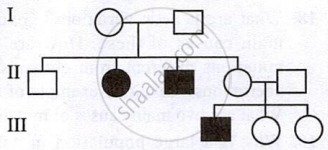
- Is the trait recessive or dominant?
- Is the trait sex-linked or autosomal?
- Give the genotypes of the parents of generation I and their third and fourth child in generation II.
A true breeding pea plant, homozygous for inflated green pods is crossed with another pea plant with constricted yellow pods (ffgg). What would be the phenotype and genotype of F1 and F2 generations? Give the phenotypic ratio of F2 generation.
State the generalisation proposed by Mendel on the basis of the above mentioned cross.
A true breeding pea plant homozygous for axial violet flowers is crossed with another pea plant with terminal white flowers:
- What would be the phenotype and genotype of F1 and F2 generations?
- Give the phenotypic ratio of F2 generations.
- List the Mendel’s generalisations that can be derived from the above cross.
A homozygous tall pea plant with green seeds is crossed with a dwarf pea plant with yellow seeds.
- What would be the phenotype and genotype of F1?
- Work out the phenotypic ratio of F2 generation with the help of Punnett square.
A tall pea plant with yellow seeds (heterozygous for both the traits) is crossed with a dwarf pea plant with green seeds. Using a Punnett square work out the cross to show the phenotypes and genotypes of F1 generation.
A Snapdragon plant homozygous for red flower when crossed with white flowered plant of the same species produced pink flowers in F1 generation.
- What is this phenotype expression called?
- Work out the cross to show the F2 generation when F1 was self pollinated. Give the phenotypic and genotypic ratios of F2 generation.
- How do you compare F2 phenotypіс and genotypic ratios with those of Mendelian monohybrid F2 ratio?
Inheritance pattern of flower colour in garden pea plant and snapdragon differs. Why is this difference observed? Explain it by showing the crosses in F1 and F2 generation. Give phenotypes and genotypes of offsprings formed.
You are given a red flower bearing pea plant and a red flowre bearing snapdragon plant. How would you find the genotypes of these two plants with respect to the colour of the flower? Explain with the help of crosses. Comment upon the pattern of inheritance seen in these two plants.
A plant of Antirrhinum majus with red flowers was crossed with another plant of the same species having white flowers. The plants of F1 generation bore pink flowers. Explain the pattern of inheritance with the help of a cross.
A woman with blood group O married a man with AB blood group. Show the possible blood groups ofthe progeny. List the alleles involved in this inheritance.
Briefly explain the following term:
Monohybrid cross
Explain the term:
Gene
Explain the term ‘Phenotype’?
- A pure tall plant (TT) is crossed with a pure dwarf plant (tt). Draw Punnett squares to show
- F1, generation
- F2 generation.
- Give the phenotype of F2 generation.
- Give the phenotype and genotypic ratios of the F1 and F2 generations.
A homozygous plant having round (R) and yellow (Y) seed is crossed with a homozygous plant having wrinkled (r) and green (y) seeds.
- Draw a Punnett square to show F1 generation.
- Give the genotype of F1 generation
- Give the dihybrid phenotypic ratio and the phenotype of the offspring of the F2 generation when two plants of the F1 generation are crossed.
- Name and state the law which explains the dihybrid ratio.
- Mention the phenotype and genotype ratios of the offsprings in F2 generation.
E. BOARD QUESTIONS 1 mark
Define polygenic inheritance.
Each of the following sub-parts, (i) to (iv) has four choices. Choose the best option:
Study the given monohybrid cross:
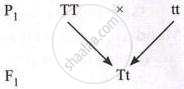
A test cross for this F1 will be:
Tt × TT
Tt × tt
Tt × Tt
TT × tt
What is emasculation?
2 marks
A woman with blood group O married a man with AB blood group. Show the possible blood groups ofthe progeny. List the alleles involved in this inheritance.
3 marks
A homozygous pea plant with round seed coat and yellow cotyledons are crossed with another homozygous, pea plant having wrinkled seed coat and green cotyledons.
- Give the types of gametes produced by plants of F1-generation.
- Give the dihybrid phenotypic ratio with the corresponding phenotypes.
- State Mendel’s principle involved in this cross.
Solutions for 5: Principles of Inheritance and Variation
Sarita Aggarwal solutions for Biology [English] Class 12 ISC chapter 5 - Principles of Inheritance and Variation
Shaalaa.com has the CISCE Mathematics Biology [English] Class 12 ISC CISCE solutions in a manner that help students grasp basic concepts better and faster. The detailed, step-by-step solutions will help you understand the concepts better and clarify any confusion. Sarita Aggarwal solutions for Mathematics Biology [English] Class 12 ISC CISCE 5 (Principles of Inheritance and Variation) include all questions with answers and detailed explanations. This will clear students' doubts about questions and improve their application skills while preparing for board exams.
Further, we at Shaalaa.com provide such solutions so students can prepare for written exams. Sarita Aggarwal textbook solutions can be a core help for self-study and provide excellent self-help guidance for students.
Concepts covered in Biology [English] Class 12 ISC chapter 5 Principles of Inheritance and Variation are .
Using Sarita Aggarwal Biology [English] Class 12 ISC solutions Principles of Inheritance and Variation exercise by students is an easy way to prepare for the exams, as they involve solutions arranged chapter-wise and also page-wise. The questions involved in Sarita Aggarwal Solutions are essential questions that can be asked in the final exam. Maximum CISCE Biology [English] Class 12 ISC students prefer Sarita Aggarwal Textbook Solutions to score more in exams.
Get the free view of Chapter 5, Principles of Inheritance and Variation Biology [English] Class 12 ISC additional questions for Mathematics Biology [English] Class 12 ISC CISCE, and you can use Shaalaa.com to keep it handy for your exam preparation.
