Advertisements
Chapters
1: Rational and Irrational Numbers
UNIT-II: COMMERCIAL MATHEMATICS
2: Compound Interest
UNIT-III: ALGEBRA
3: Expansions
4: Factorisation
5: Simultaneous Linear Equations
6: Indices
7: Logarithms
UNIT-IV: GEOMETRY
8: Triangles
9: Inequalities
10: Mid-point Theorem
11: Pythagoras Theorem
12: Rectilinear Figures (Theorems on Parallelograms and Construction of Polygons)
13: Theorems on Area
14: Circles (Chord and Arc Properties)
UNIT-V: STATISTICS
15: Statistics
16: Graphical Representation of Statistical Data
UNIT-VI: MENSURATION
17: Mensuration
18: Surface Area and Volume of Solids
UNIT-VII: TRIGONOMETRY
19: Trigonometry
20: Simple 2-D Problems in Right Triangle
UNIT-VIII: COORDINATE GEOMETRY
▶ 21: Coordinate Geometry
![B Nirmala Shastry solutions for Mathematics [English] Class 9 ICSE chapter 21 - Coordinate Geometry - Shaalaa.com](/images/mathematics-english-class-9-icse_6:a927b361d63845f4b2afea4ec6bbe35a.jpg "B Nirmala Shastry solutions for Mathematics [English] Class 9 ICSE chapter 21 - Coordinate Geometry")
Advertisements
Solutions for Chapter 21: Coordinate Geometry
Below listed, you can find solutions for Chapter 21 of CISCE B Nirmala Shastry for Mathematics [English] Class 9 ICSE.
B Nirmala Shastry solutions for Mathematics [English] Class 9 ICSE 21 Coordinate Geometry EXERCISE 21A [Page 251]
Plot A(−3, 0), B(0, 4) and C(3, 4) on graph paper. Plot a point D and write its coordinates if ABCD is a parallelogram. Find its area and perimeter.
Plot P(8,-2), Q(4, 3) and R(-2, 3) on a graph paper. If PQRS is an isosceles trapezium, locate S and write its coordinates. Find its area.
Plot C(l, −3), D(5, −6), E(5, 4) and F(1, 1) on a graph paper. What kind of quadrilateral is CDEF? Find its area and perimeter.
Plot A(0, 2), B(2, 3), C(4, 2) and D(2, -4) on a graph paper. Classify the quadrilateral ABCD. Find its area.
Plot the following point and verify if it is collinear.
A(−1, 2), B(3, −1) and C(7, −4)
Plot the following point and verify if it is collinear.
P(−2, −1), Q(2, 1) and R(8, 4)
Plot the following point and verify if it is collinear.
M(−2, 5), N(4, 2) and P(8, 0)
Plot the following point and verify if it is collinear.
D(1, −2), E(3, 1) and F(6, 6)
Plot A(3, 0) and B(8, 5). If points C(2, p) and D(q, 1) lie on the line AB, find the values of p and q.
Plot P(−2, 4) and Q(4, 1). If line PQ passes through R(a, 3) and S(2, b), find the values of a and b.
B Nirmala Shastry solutions for Mathematics [English] Class 9 ICSE 21 Coordinate Geometry EXERCISE 21B [Page 257]
Solve the following pair of simultaneous equations graphically.
x − 2y + 3 = 0
2x + y = 14
Solve the following pair of simultaneous equations graphically.
2x − y = 4
x − y = 1
Solve the following pair of simultaneous equations graphically.
x − y + 1 = 0
x + y = 5
Solve the following pair of simultaneous equations graphically.
2x − 7y = 6
5x − 8y = −4
Solve the following pair of simultaneous equations graphically.
3x + 2y + 4 = 0
x + 3y = 1
Solve the following pair of simultaneous equations graphically.
3y − 2x = 7
5x + 3y + 7 = 0
Taking scale 2 cm = 1 unit, draw the graph of the following and find the solution set.
x + 3y = 5
2x − y = 3
Taking scale 2 cm = 1 unit, draw the graph of the following and find the solution set.
4x + 3y = 5
x − 2y + 7 = 0
Taking scale 2 cm = 1 unit, draw the graph of the following and find the solution set.
x + 2y = 4
3x - 4 = 2y
Taking scale 2 cm = 1 unit, draw the graph of the following and find the solution set.
x + y + 2 = 0
3x − 4y = 15
Taking scale 2 cm = 1 unit, draw the graph of the following and find the solution set.
3x + 5y = 12
3x − 5y + 18 = 0
Taking scale 2 cm = 1 unit, draw the graph of the following and find the solution set.
2x + 3y + 2 = 0
4x + 5y = 0
Find the coordinates of the vertices and the area of the triangle enclosed by the y-axis and the graphs of x + 3y = 12 and x − 3y = 0.
Find the area of the triangular region whose vertices are the points of intersection of the graphs 2x + y = 5, y = x − 4 and y = 5.
Find graphically the vertices of triangle whose sides are 3x + 4y = 12, y − 6 = 0 and y = 2x − 8. Find the area of the triangle.
Draw the graphs of 3x = 4y + 32 and 3x + 4y = 16. Find the coordinates of the vertices of the triangle formed by the lines with y + 2 = 0. Find the perimeter of the triangle.
B Nirmala Shastry solutions for Mathematics [English] Class 9 ICSE 21 Coordinate Geometry EXERCISE 21C [Pages 260 - 261]
Find the distance between the following points:
(3, 5); (6, 9)
Find the distance between the following points:
(1, 2); (−5, −6)
Find the distance between the following points:
(−2, −5); (6, −20)
Find the distance between the following points:
`(6 1/2, −3 3/4); (−2 1/2, 8 1/4)`
Find the distance between the following points:
`(3sqrt3, 6); (sqrt3, 4)`
A is on x-axis with abscissa 4 and B ≡ (−1, −12). Find the distance between A and B.
P is on y-axis whose ordinate is 3 and Q ≡ (12, −13). Find the distance between P and Q.
Find the coordinates of circumcentre of ΔPQR where P ≡ (6, −5), Q ≡ (6, 7), R ≡ (8, 7).
Find the coordinates of a point on x-axis which is equidistant from A(2, −4) and B(8, 4).
Find the coordinates of a point P on y-axis so that PA ≡ PB where A ≡ (−2, 4) and B ≡ (−5, −3).
P is a point on x-axis with abscissa −6 and Q is (2, 15). Find the distance between P and Q.
Find the coordinates of points whose abscissa is −4 and which are at a distance of 15 units from (5, −9).
Prove that A(−5, 4), B(−1, −2), C(5, 2) are the vertices of an isosceles right-angled triangle.
The centre of a circle is (2, 6) and its radius is 13 units. Find x, if P(x, 2x) is a point on the circumference of the circle.
Prove that P(−2, 2), Q(1, 4) and R(7, 8) are collinear.
Prove that A(7, 13), B(3, 9) and C(−6, 0) are collinear.
The distance between P(12, 6) and Q is 20 units. If Q is on y-axis, find the coordinates of Q.
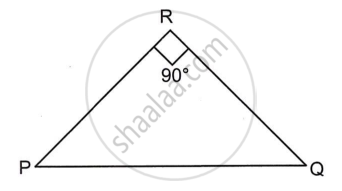
In ΔPQR, ∠R = 90°, P = (8, −7), Q = (2, 1) and QR = 8 units. Find the length of the PQ and PR.
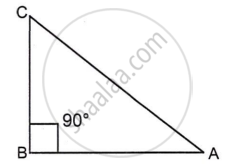
In ΔABC, ∠ABC = 90° C = (2, 0) and B = (−2, 3). If AC = 13 units, find the lengths of BC and AB.
If A(4, 3), B(6, −2) and C(a, −3) are the vertices of a triangle right angled at A, find a.
The abscissa of a point A is twice its ordinate and B ≡ (10, 0). Find the coordinates of A if AB = 5 units.
Given A ≡ (x, x + 1) and B ≡ (3, 7). Find x, if AB = 15 units.
P is a point whose ordinate and abscissa are same. Q ≡ (7, 11). If length of PQ = 20, find the coordinates of P.
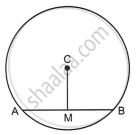
C(10, 4) is the centre of the circle with radius 17 units. CM ⊥ chord AB and M ≡ (1, −8). Calculate the lengths of AM and AB.
If A = (8, −10) and B = (−4, 6), find the length of AB. 1 If MN = `1/2` AB, where M = (k, 5) and N = (4, −3), find the value of k.
B Nirmala Shastry solutions for Mathematics [English] Class 9 ICSE 21 Coordinate Geometry MULTIPLE CHOICE QUESTIONS [Pages 261 - 262]
Point (2, −5) lies in ______.
first quadrant
second quadrant
third quadrant
fourth quadrant
Which point lies on X axis?
(2, −3)
(5, −1)
(3, 0)
(0, −6)
(4, 6) is 6 units from ______.
origin
x axis
y axis
cannot say
Which point A (7, 2), B (−4, −3), C (−5, 1), D (6, −2) lies in the second quadrant?
A
B
C
D
The distance of point (−3, 4) from the origin is ______.
3 units
− 3 units
4 units
5 units
The distance between A(6, 0) and B(0, −8) is ______.
6 units
8 units
10 units
− 8 units
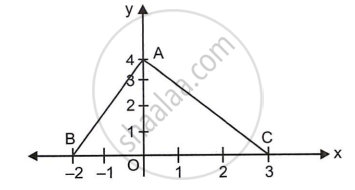
The coordinates of A and B are ______.
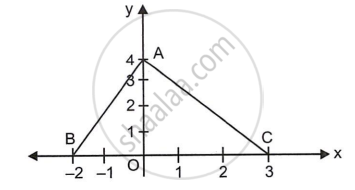
A(4, 0), B(−2, 0)
A(0, 4), B(0, −2)
A(0, 4), B(−2, 0)
A(4, 0), B(0, −2)
Area of ΔABC is ______.
20 sq. units
10 sq. units
6 sq. units
12 sq. units
The point A is on X axis with abscissa, 5 and B is on y axis with ordinate 12. ∴ The length of AB is ______.
5 units
12 units
13 units
15 units
If A(−4, 0), B(6, 0), the length of AB is ______.
2 units
6 units
4 units
10 units
A is a point on X axis with abscissa -5, B is (4, 12). ∴ The length of AB is ______.
15 units
17 units
21 units
11 units
Which of the following points lie on the line 2x − 5y = 16?
(1, −3)
(3, −2)
(8, 1)
(0, 8)
A(6, 0), B(0, 8), O(0, 0).
ΔABO is ______.
acute angled Δ
obtuse angled Δ
right angled Δ
isosceles Δ
A(6, 0), B(0, 8), O(0, 0).
Perimeter of the triangle is ______.
14 units
19 units
20 units
24 units
A(4, −3), B(−8, 2), the length of AB is ______.
13 units
15 units
17 units
20 units
Which point is 5 units from A (3,−2)?
(0, 0)
(−1, 1)
(1, 0)
(1, 1)
If (2p, − p) lies on the line 3x − 4y + 20 = 0, then the value of p is ______.
2
−2
4
3
Direction for Questions 16 to 20: In each of the following questions, a statement of assertion (A) is given and a statement of reason (R) given below it. Choose the correct option for each question.
Assertion: The ordinate of (5, 4) is 4.
Reason: The perpendicular distance of a point from x-axis is the absolute value of its ordinate.
Both A and R are true and R is the correct reason for A.
Both A and R are true but R is the incorrect reason for A.
A is true but R is false.
A is false but R is true.
Assertion: The point (−3, 0) lies on x-axis.
Reason: Every point on the x-axis has zero distance from the x-axis.
Both A and R are true and R is the correct reason for A.
Both A and R are true but R is the incorrect reason for A.
A is true but R is false.
A is false but R is true.
Assertion: The point (2, −3) lies in IV quadrant.
Reason: The perpendicular distance of a point from y-axis is called its abscissa.
Both A and R are true and R is the correct reason for A.
Both A and R are true but R is the incorrect reason for A.
A is true but R is false.
A is false but R is true.
Assertion: A is on Y axis with ordinate 6. B is on X axis with abscissa −8. ∴ AB = 10 units.
Reason: The co-ordinate axes are perpendicular to each other.
Both A and R are true and R is the correct reason for A.
Both A and R are true but R is the incorrect reason for A.
A is true but R is false.
A is false but R is true.
Assertion: A point whose both coordinates are negative lies in the third quadrant.
Reason: If the ordinate and abscissa of a point are equal then the point lies in the first or third quadrant.
Both A and R are true and R is the correct reason for A.
Both A and R are true but R is the incorrect reason for A.
A is true but R is false.
A is false but R is true.
B Nirmala Shastry solutions for Mathematics [English] Class 9 ICSE 21 Coordinate Geometry MISCELLANEOUS EXERCISE [Pages 262 - 263]
Complete the following table for the line 5y = 3x + 7 and plot it on the graph.
| x | 1 | −9 | −4 | ||
| y | 8 | 5 |
Draw the graph of the following lines:
4x + 3y = 12 and 2x − 3y = 6
Find the solution set and the area of triangle formed by the two lines with y-axis.
Draw the graph of the following lines: y = x + 2 and 5x + 3y = 30.
Find their point of intersection and the area of triangle formed by the two lines with x-axis.
Draw the following lines 3x + 7y = 16, x + 4 = 0 and 7y = 3x − 2. Write the coordinates of the points of intersection of the lines. What type of triangle is formed? Find its area.
Solve graphically the following set of equations:
5x + y = 11 and 2y − 3x + 4 = 0
Solve graphically the following set of equations:
5x + 4y = 30 and 3y = 5x + 5
Name the figure formed by plotting the following points. Also, find the area of the figure.
P(2, 7), Q(−3, 1), R(2, 4), S(7, 1)
Name the figure formed by plotting the following point. Also, find the area of the figure.
A(6, 6), B(2, 2), C(6, −2), O(10, 2)
Name the figure formed by plotting the following point. Also, find the area of the figure.
C(0, 4), D(−5, −2), E(1, −2), F(6, 4)
Name the quadrilateral formed by plotting the following point. Also, find the perimeter.
A(0, 4), B(4, 7), C(8, 4), D(4, 1)
Name the quadrilateral formed by plotting the following points. Also, find the perimeter.
C(5, 1), D(−1, 9), E(−5, 6), F(1, −2)
Name the quadrilateral formed by plotting the following points. Also, find the perimeter.
P(5, 2), Q(2, 6), R(2, −6), S(5, −2)
If A = (−4, 3) and B = (8, −6)
- Find the length of AB.
- In what ratio is the line joining A and B, divided by the x-axis?
Find the points on y-axis which are at a distance of 13 units from B(5, 14).
Which point on x-axis is equidistant from A(−4, 12) and B(−7, 9)?
If K = (2, 5) and M = (x, −7) and length of KM = 13 units, find the value of x.
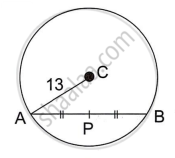
The centre of a circle of radius 13 units is the point (3, 6). P(7, 9) is a point inside the circle. APB is a chord of the circle such that AP = PB. Calculate the length of AB.
Calculate the distance between A (7, 3) and B on the x-axis, whose abscissa is 11.
Prove that A(0, 7), B(4, 3), C(6, 5) form the vertices of a right-angled triangle.
Prove that P(−1, 0), Q(1, 3) and R(5, 9) are collinear.
P(−1, 2), A(2, k) and B(k, −1) are given points. If PA = PB, find the value of k.
P(−5, 7), A(3, k) and B(k, −1) are given points. If PA = PB, find the value of k.
In ΔABC, ∠ABC = 90°, A(6, − 7), B(−3, 5) and BC = 20 units. Find the length of AB and AC.
Solutions for 21: Coordinate Geometry
B Nirmala Shastry solutions for Mathematics [English] Class 9 ICSE chapter 21 - Coordinate Geometry
Shaalaa.com has the CISCE Mathematics Mathematics [English] Class 9 ICSE CISCE solutions in a manner that help students grasp basic concepts better and faster. The detailed, step-by-step solutions will help you understand the concepts better and clarify any confusion. B Nirmala Shastry solutions for Mathematics Mathematics [English] Class 9 ICSE CISCE 21 (Coordinate Geometry) include all questions with answers and detailed explanations. This will clear students' doubts about questions and improve their application skills while preparing for board exams.
Further, we at Shaalaa.com provide such solutions so students can prepare for written exams. B Nirmala Shastry textbook solutions can be a core help for self-study and provide excellent self-help guidance for students.
Concepts covered in Mathematics [English] Class 9 ICSE chapter 21 Coordinate Geometry are .
Using B Nirmala Shastry Mathematics [English] Class 9 ICSE solutions Coordinate Geometry exercise by students is an easy way to prepare for the exams, as they involve solutions arranged chapter-wise and also page-wise. The questions involved in B Nirmala Shastry Solutions are essential questions that can be asked in the final exam. Maximum CISCE Mathematics [English] Class 9 ICSE students prefer B Nirmala Shastry Textbook Solutions to score more in exams.
Get the free view of Chapter 21, Coordinate Geometry Mathematics [English] Class 9 ICSE additional questions for Mathematics Mathematics [English] Class 9 ICSE CISCE, and you can use Shaalaa.com to keep it handy for your exam preparation.
