Advertisements
Advertisements
Question
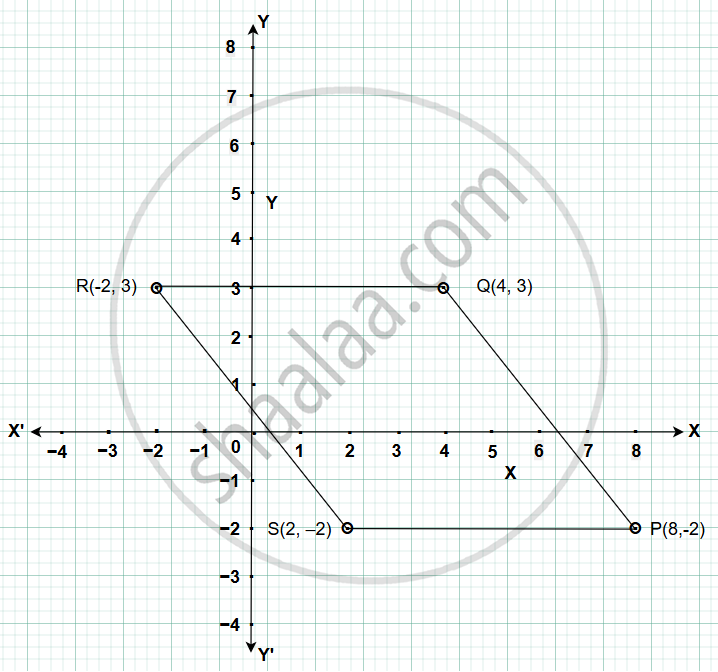
Plot P(8,-2), Q(4, 3) and R(-2, 3) on a graph paper. If PQRS is an isosceles trapezium, locate S and write its coordinates. Find its area.
Graph
Sum
Advertisements
Solution
PQRS,
Area = `1/2` × (sum of parallel sides) × height
PQ = 8 − 4 = 4 units
RS = 2 − (−2) = 4 units ... [PQ and RS are not parallel; actually, QR parallel PS.]
QR = 6 (from (−2, 3) to (4, 3))
PS = 6 (from (2,−2) to (8,−2))
QR = 6 and PS = 6
The isosceles condition (equal non-parallel sides):
PQ = `sqrt((4 − 8)^2 + (3 − (− 2))^2)`
PQ = `sqrt(16 + 25)`
PQ = `sqrt41`
RS = `sqrt((2 − (− 2))^2 + (−2 − 3)^2)`
RS = `sqrt(16 + 25)`
RS = `sqrt41`
Height = difference in y = 3 − (−2) = 5
Area = `1/2 xx (6 + 6) xx 5`
Area = `1/2 xx 12 xx 5`
Area = 30
shaalaa.com
Is there an error in this question or solution?
