Please select a subject first
Advertisements
Advertisements
To convert mechanical energy into electrical energy, one can use
(a) DC dynamo
(b) AC dynamo
(c) motor
(d) transformer
Concept: undefined >> undefined
When a Coolidge tube is operated for some time it becomes hot. Where does the heat come from?
Concept: undefined >> undefined
Advertisements
In a Coolidge tube, electrons strike the target and stop inside it. Does the target get more and more negatively charged as time passes?
Concept: undefined >> undefined
Can X-rays be used for photoelectric effect?
Concept: undefined >> undefined
Can X-rays be polarised?
Concept: undefined >> undefined
X-ray and visible light travel at the same speed in vacuum. Do they travel at the same speed in glass?
Concept: undefined >> undefined
Characteristic X-rays may be used to identify the element from which they are being emitted. Can continuous X-rays be used for this purpose?
Concept: undefined >> undefined
Is it possible that in a Coolidge tube characteristic Lα X-rays are emitted but not Kα X-rays?
Concept: undefined >> undefined
Can Lα X-ray of one material have shorter wavelength than Kα X-ray of another?
Concept: undefined >> undefined
Can a hydrogen atom emit characteristic X-rays?
Concept: undefined >> undefined
Why is exposure to X-rays injurious to health but not exposure to visible light, when both are electromagnetic waves?
Concept: undefined >> undefined
An X-ray beam can be deflected
Concept: undefined >> undefined
Consider a photon of a continuous X-ray coming from a Coolidge tube. Its energy comes from
Concept: undefined >> undefined
The energy of a photon of a characteristic X-ray from a Coolidge tube comes from
Concept: undefined >> undefined
If the potential difference applied to the tube is doubled and the separation between the filament and the target is also doubled, the cutoff wavelength
Concept: undefined >> undefined
If the current in the circuit for heating the filament is increased, the cutoff wavelength
Concept: undefined >> undefined
Moseley's Law for characteristic X-ray is √v = a(Z − b). Here,
Concept: undefined >> undefined
Frequencies of Kα X-rays of different materials are measured. Which one of the graphs in the figure may represent the relation between the frequency v and the atomic number Z ?
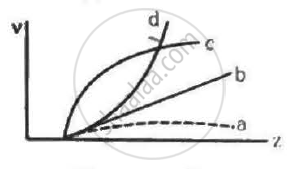
Concept: undefined >> undefined
The X-ray beam emerging from an X-ray tube
Concept: undefined >> undefined
One of the following wavelengths is absent and the rest are present in the X-rays coming from a Coolidge tube. Which one is the absent wavelength?
Concept: undefined >> undefined
