Advertisements
Advertisements
Question
To convert mechanical energy into electrical energy, one can use
(a) DC dynamo
(b) AC dynamo
(c) motor
(d) transformer
Advertisements
Solution
(a) DC dynamo
(b) AC dynamo
An AC or DC dynamo can be used to convert mechanical energy to electrical energy.
A motor converts electrical energy to mechanical energy and a transformer is used to step up or down the voltage or simply to transfer electrical energy.
APPEARS IN
RELATED QUESTIONS
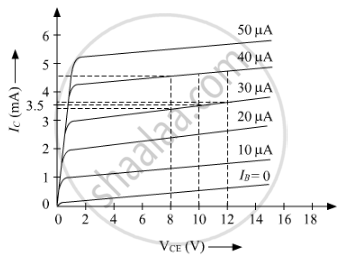
Output characteristics of an n-p-n transistor in CE configuration is shown in the figure.
Determine:
(i) dynamic output resistance
(ii) dc current gain and
(iii) ac current gain at an operating point VCE = 10 V, when IB = 30 μA.
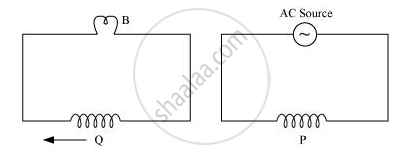
A coil Q is connected to low voltage bulb B and placed near another coil P as shown in the figure. Give reasons to explain the following observations:
(a) The bulb ‘B’ lights
(b) Bulb gets dimmer if the coil Q is moved towards left.
An A.C. source is connected to a resistive circuit. Which of the following is true?
How does the sign of the phase angle `phi`, by which the supply voltage leads the current in an LCR series circuit, change as the supply frequency is gradually increased from very low to very high values.
A phasor is best described as ______.
The vertical component of a voltage phasor V at any instant represents ______.
Phasor diagrams are primarily used in AC circuit analysis to ______.
What does the vertical component of a phasor give at any instant?
What does the magnitude (length) of a phasor equal?
At what angular velocity does a phasor rotate about the origin?
Which expression gives the vertical component of a voltage phasor?
Which expression gives the vertical component of a current phasor?
What is the phase angle between the voltage and current phasors for a pure resistor?
What is the relationship between the voltage and current phasors in a pure resistor?
Does the in-phase relationship of a pure resistor hold for any combination of a pure resistor, a pure inductor, and a pure capacitor?
