Please select a subject first
Advertisements
Advertisements
Consider a uniformly charged ring of radius R. Find the point on the axis where the electric field is maximum.
Concept: undefined >> undefined
A wire is bent in the form of a regular hexagon and a total charge q is distributed uniformly on it. What is the electric field at the centre? You may answer this part without making any numerical calculations.
Concept: undefined >> undefined
Advertisements
A particle of mass m and charge q is thrown at a speed u against a uniform electric field E. How much distance will it travel before coming to momentary rest ?
Concept: undefined >> undefined
A particle of mass 1 g and charge 2.5 × 10⁻⁴ C is released from rest in an electric field of 1.2 × 10 4 N C−1. Find the electric force and the force of gravity acting on this particle. Can one of these forces be neglected in comparison with the other for approximate analysis?
Concept: undefined >> undefined
A particle of mass 1 g and charge 2.5 × 10⁻⁴ C is released from rest in an electric field of 1.2 × 10 4 N C−1. How long will it take for the particle to travel a distance of 40 cm?
Concept: undefined >> undefined
A particle of mass 1 g and charge 2.5 × 10⁻⁴ C is released from rest in an electric field of 1.2 × 10 4 N C−1. What will be the speed of the particle after travelling this distance?
Concept: undefined >> undefined
A particle of mass 1 g and charge 2.5 × 10⁻⁴ C is released from rest in an electric field of 1.2 × 10 4 N C−1. How much is the work done by the electric force on the particle during this period?
Concept: undefined >> undefined
A ball of mass 100 g and with a charge of 4.9 × 10⁻⁵ C is released from rest in a region where a horizontal electric field of 2.0 × 10⁴ N C−1 exists. (a) Find the resultant force acting on the ball. (b) What will be the path of the ball? (c) Where will the ball be at the end of 2 s?
Concept: undefined >> undefined
A block of mass m with a charge q is placed on a smooth horizontal table and is connected to a wall through an unstressed spring of spring constant k, as shown in the figure. A horizontal electric field E, parallel to the spring, is switched on. Find the amplitude of the resulting SHM of the block. 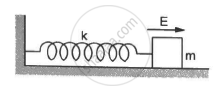
Concept: undefined >> undefined
12 J of work has to be done against an existing electric field to take a charge of 0.01 C from A to B. How much is the potential difference VB − VA?
Concept: undefined >> undefined
An electric field of 20 NC−1 exists along the x-axis in space. Calculate the potential difference VB − VA where the points A and B are
(a) A = (0, 0); B = (4 m, 2m)
(b) A = (4 m, 2 m); B = (6 m, 5 m)
(c) A = (0, 0); B = (6 m, 5 m)
Do you find any relation between the answers of parts (a), (b) and (c)?
Concept: undefined >> undefined
Consider the situation of the previous problem. A charge of −2.0 × 10⁻⁴ C is moved from point A to point B. Find the change in electrical potential energy UB − UA for the cases (a), (b) and (c).
Concept: undefined >> undefined
A capacitor having a capacitance of 100 µF is charged to a potential difference of 24 V. The charging battery is disconnected and the capacitor is connected to another battery of emf 12 V with the positive plate of the capacitor joined with the positive terminal of the battery. (a) Find the charges on the capacitor before and after the reconnection. (b) Find the charge flown through the 12 V battery. (c) Is work done by the battery or is it done on the battery? Find its magnitude. (d) Find the decrease in electrostatic field energy. (e) Find the heat developed during the flow of charge after reconnection.
Concept: undefined >> undefined
An electric field \[\vec{E} = ( \vec{i} 20 + \vec{j} 30) {NC}^{- 1}\] exists in space. If the potential at the origin is taken to be zero, find the potential at (2 m, 2 m).
Concept: undefined >> undefined
An electric field \[\vec{E} = \vec{i}\] Ax exists in space, where A = 10 V m−2. Take the potential at (10 m, 20 m) to be zero. Find the potential at the origin.
Concept: undefined >> undefined
The electric potential existing in space is \[\hspace{0.167em} V(x, y, z) = A(xy + yz + zx) .\] (a) Write the dimensional formula of A. (b) Find the expression for the electric field. (c) If A is 10 SI units, find the magnitude of the electric field at (1 m, 1 m, 1 m).
Concept: undefined >> undefined
The kinetic energy of a charged particle decreases by 10 J as it moves from a point at potential 100 V to a point at potential 200 V. Find the charge on the particle.
Concept: undefined >> undefined
Find the magnitude of the electric field at the point P in the configuration shown in the figure for d >> a.
Concept: undefined >> undefined
Assume that each atom in a copper wire contributes one free electron. Estimate the number of free electrons in a copper wire of mass 6.4 g (take the atomic weight of copper to be 64 g mol−1).
Concept: undefined >> undefined
The magnetic field inside a tightly wound, long solenoid is B = µ0 ni. It suggests that the field does not depend on the total length of the solenoid, and hence if we add more loops at the ends of a solenoid the field should not increase. Explain qualitatively why the extra-added loops do not have a considerable effect on the field inside the solenoid.
Concept: undefined >> undefined
