Advertisements
Advertisements
A converging lens and a diverging mirror are placed at a separation of 15 cm. The focal length of the lens is 25 cm and that of the mirror is 40 cm. Where should a point source be placed between the lens and the mirror so that the light, after getting reflected by the mirror and then getting transmitted by the lens, comes out parallel to the principal axis?
Concept: undefined >> undefined
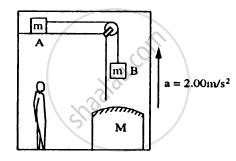
Consider the situation shown in figure. The elevator is going up with an acceleration of 2.00 m s−2 and the focal length of the mirror is 12.0 cm. All the surfaces are smooth and the pulley is light. The mass-pulley system is released from rest (with respect to the elevator) at t = 0 when the distance of B from the mirror is 42.0 cm. Find the distance between the image of the block B and the mirror at t = 0.200 s. Take g = 10 m s−2.
Concept: undefined >> undefined
Advertisements
A parallel-plate capacitor of plate-area A and plate separation d is joined to a battery of emf ε and internal resistance R at t = 0. Consider a plane surface of area A/2, parallel to the plates and situated symmetrically between them. Find the displacement current through this surface as a function of time.
Concept: undefined >> undefined
To convert mechanical energy into electrical energy, one can use
(a) DC dynamo
(b) AC dynamo
(c) motor
(d) transformer
Concept: undefined >> undefined
A molecule of hydrogen contains two protons and two electrons. The nuclear force between these two protons is always neglected while discussing the behaviour of a hydrogen molecule. Why?
Concept: undefined >> undefined
How will the thermionic current vary if the filament current is increased?
Concept: undefined >> undefined
Would you prefer a material with a high melting point or a low melting point to be used as a cathode in a diode?
Concept: undefined >> undefined
Would you prefer a material with a high work-function or a low work-function to be used as a cathode in a diode?
Concept: undefined >> undefined
An isolated metal sphere is heated to a high temperature. Will it become positively charged due to thermionic emission?
Concept: undefined >> undefined
A diode value is connected to a battery and a load resistance. The filament is heated, so that a constant current is obtained in the circuit. As the cathode continuously emits electrons, does it become more and more positively charged?
Concept: undefined >> undefined
Why does thermionic emission not take place in non-conductors?
Concept: undefined >> undefined
The cathode of a diode valve is replaced by another cathode of double the surface area. Keeping the voltage and temperature conditions the same, will the place current decrease, increase or remain the same?
Concept: undefined >> undefined
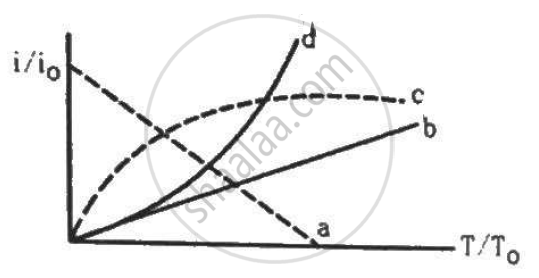
Let i0 be the thermionic current from a metal surface when the absolute temperature of the surface is T0. The temperature is slowly increased and the thermionic current is measured as a function of temperature. Which of the following plots may represent the variation in (i/i0) against (T/T0)?
Concept: undefined >> undefined
The anode of a thermionic diode is connected to the negative terminal of a battery and the cathode to its positive terminal.
Concept: undefined >> undefined
The constant A in the Richardson−Dushman equation for tungsten is 60 × 104 A m−2K−2. The work function of tungsten is 4.5 eV. A tungsten cathode with a surface area 2.0 × 10⁻⁵ m2 is heated by a 24 W electric heater. In steady state, the heat radiated by the heater and the cathode equals the energy input by the heater and the temperature becomes constant. Assuming that the cathode radiates like a blackbody, calculate the saturation current due to thermions. Take Stefan's Constant = 6 × 10⁻⁸ W m−2 K−1. Assume that the thermions take only a small fraction of the heat supplied.
Concept: undefined >> undefined
Define the term "Threshold frequency", in the context of photoelectric emission.
Concept: undefined >> undefined
Define the term wavefront. Using Huygen’s wave theory, verify the law of reflection.
Concept: undefined >> undefined
Answer the following question.
Three photodiodes D1, D2, and D3 are made of semiconductors having band gaps of 2.5 eV, 2 eV, and 3 eV respectively. Which of them will not be able to detect light of wavelength 600 nm?
Concept: undefined >> undefined
Answer the following question.
Under what conditions is the phenomenon of total internal reflection of light observed? Obtain the relation between the critical angle of incidence and the refractive index of the medium.
Concept: undefined >> undefined
Answer the following question.
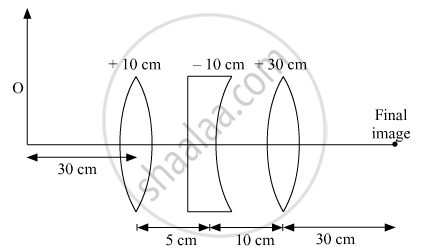
Three lenses of focal length +10 cm, —10 cm and +30 cm are arranged coaxially as in the figure given below. Find the position of the final image formed by the combination.
Concept: undefined >> undefined
