Advertisements
Advertisements
Question
Answer the following question.
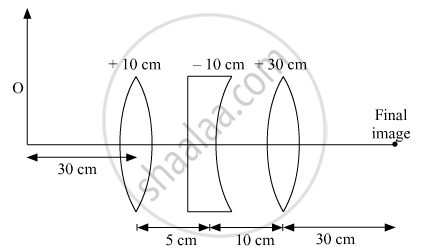
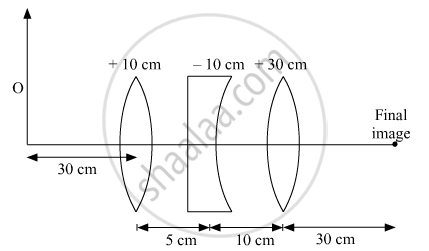
Three lenses of focal length +10 cm, —10 cm and +30 cm are arranged coaxially as in the figure given below. Find the position of the final image formed by the combination.
Advertisements
Solution
`1/v - 1/u = 1/f`
`u = -30 cm`
`f = +10 cm`
`1/nu = 1/f + 1/u`
`1/nu_1 = 1/10 - 1/30`
⇒ `1/nu_1 = (3 - 1)/30 = 2/30`
`nu_1 = 15` cm
`u = +10 cm`
`f = -10 cm`
`1/nu_2 = 1/f + 1/u = 1/10 - 1/10`
`nu_2 = ∞`
For third lens object is at infinity hence image is formed at focus final image at a distance of 30 cm.
RELATED QUESTIONS
A small candle, 2.5 cm in size is placed at 27 cm in front of a concave mirror of radius of curvature 36 cm. At what distance from the mirror should a screen be placed in order to obtain a sharp image? Describe the nature and size of the image. If the candle is moved closer to the mirror, how would the screen have to be moved?
If an object far away from a convex mirror moves towards the mirror, the image also moves. Does it move faster, slower or at the same speed as compared to the object?
A converging lens and a diverging mirror are placed at a separation of 15 cm. The focal length of the lens is 25 cm and that of the mirror is 40 cm. Where should a point source be placed between the lens and the mirror so that the light, after getting reflected by the mirror and then getting transmitted by the lens, comes out parallel to the principal axis?
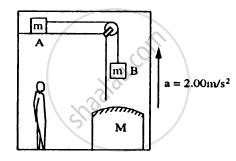
Consider the situation shown in figure. The elevator is going up with an acceleration of 2.00 m s−2 and the focal length of the mirror is 12.0 cm. All the surfaces are smooth and the pulley is light. The mass-pulley system is released from rest (with respect to the elevator) at t = 0 when the distance of B from the mirror is 42.0 cm. Find the distance between the image of the block B and the mirror at t = 0.200 s. Take g = 10 m s−2.
With the help of a ray diagram, obtain the relation between its focal length and radius of curvature.
The focal length of a convex lens made of glass of refractive index (1.5) is 20 cm.
What will be its new focal length when placed in a medium of refractive index 1.25?
Is focal length positive or negative? What does it signify?
A spherical mirror is obtained as shown in the figure from a hollow glass sphere. if an object is positioned in front of the mirror, what will be the nature and magnification of the image of the object? (Figure drawn as schematic and not to scale)

A lens of focal length f is divided into two equal parts and then these parts are put in a combination as shown in the figure below.
- What is the focal length of L1?
- What is the focal length of the final combination?

The line joining the pole and the centre of curvature of a spherical mirror is called the:
For a curved surface such as a spherical mirror, the normal used in applying the laws of reflection is taken as:
