Advertisements
Advertisements
Question
The focal length of a convex lens made of glass of refractive index (1.5) is 20 cm.
What will be its new focal length when placed in a medium of refractive index 1.25?
Is focal length positive or negative? What does it signify?
Advertisements
Solution
Given aμg = 1.5
Focal length of the given convex lens when it is placed in air is f = + 20 cm
Refractive index of the given medium with respect to air is aμm = 1.25
New focal length of the given convex lens when placed in a medium is f'
`1/"f" = ("a"_(mu"g") - 1)[(1/"R"_1) + (1/"R"_2)]` .....(A)
`1/"f'" = ("m"_(mu"g") - 1)[(1/"R"_1) + (1/"R"_2)]` .....(B)
Dividing (A) by (B), we get
`"f'"/"f" = (("a"_(mu"g") - 1))/(("m"_(mu"g") - 1)) = ((1.5 - 1))/((1.2 - 1)) = 0.5/0.2 = 5/2 = 2.5`
f' = 2.5f = (2.5 × 20) cm = +50 cm as mµg = `mu_"g"/mu_"m" = 1.5/1.25 = 1.2`
New focal length is positive.
The significance of the positive sign of the focal length is that the given convex lens is still converging in the given medium.
APPEARS IN
RELATED QUESTIONS
A 4.5 cm needle is placed 12 cm away from a convex mirror of focal length 15 cm. Give the location of the image and the magnification. Describe what happens as the needle is moved farther from the mirror.
Can mirrors give rise to chromatic aberration?
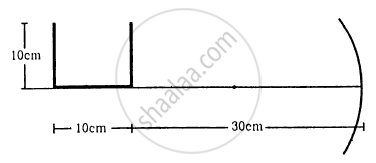
A U-shaped wire is placed before a concave mirror having radius of curvature 20 cm as shown in figure. Find the total length of the image.
The image of an extended object, placed perpendicular to the principal axis of a mirror, will be erect if
(a) the object and the image are both real
(b) the object and the image are both virtual
(c) the object is real but the image is virtual
(d) the object is virtual but the image is real.
How can the spherical aberration produced by a lens be minimized?
Two thin lenses having optical powers of -10D and+ 6D are placed in contact with each other. The focal length of the combination is:
According to Cartesian sign convention, all distances are measured from the _______.
The intensity of a point source of light, S, placed at a distance d in front of a screen A, is I0 at the center of the screen. Find the light intensity at the center of the screen if a completely reflecting plane mirror M is placed at a distance d behind the source, as shown in the figure.

The geometric centre of a spherical mirror is called its:
According to the laws of reflection, the incident ray, the reflected ray, and the normal to the reflecting surface at the point of incidence:
