Advertisements
Advertisements
Question
Define the term "Threshold frequency", in the context of photoelectric emission.
Advertisements
Solution
For a given Photosensitive material, there is a certain minimum cut off frequency at which Photoelectric emission is possible is called Threshold frequency, i.e. At this frequency just emission of photoelectrons happens without giving them any kind of additional energy. Higher the work function of the material, greater is the Threshold frequency. See the figure below of two different metals having different Threshold Frequency.
APPEARS IN
RELATED QUESTIONS
Find the maximum frequency of X-rays produced by 30 kV electrons.
Find the (a) maximum frequency and (b) minimum wavelength of X-rays produced by 30 kV electrons.
The cathode of a diode valve is replaced by another cathode of double the surface area. Keeping the voltage and temperature conditions the same, will the place current decrease, increase or remain the same?
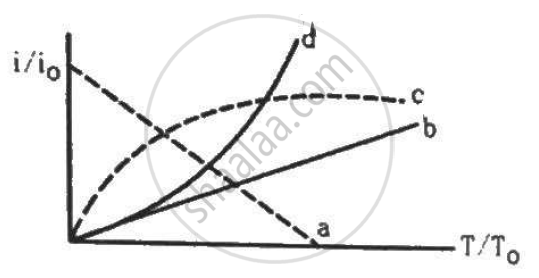
Let i0 be the thermionic current from a metal surface when the absolute temperature of the surface is T0. The temperature is slowly increased and the thermionic current is measured as a function of temperature. Which of the following plots may represent the variation in (i/i0) against (T/T0)?
The constant A in the Richardson−Dushman equation for tungsten is 60 × 104 A m−2K−2. The work function of tungsten is 4.5 eV. A tungsten cathode with a surface area 2.0 × 10⁻⁵ m2 is heated by a 24 W electric heater. In steady state, the heat radiated by the heater and the cathode equals the energy input by the heater and the temperature becomes constant. Assuming that the cathode radiates like a blackbody, calculate the saturation current due to thermions. Take Stefan's Constant = 6 × 10⁻⁸ W m−2 K−1. Assume that the thermions take only a small fraction of the heat supplied.
Answer the following question.
Define the term "Threshold frequency", in the context of photoelectric emission.
The wave associated with a moving particle of mass 3 × 10⁻⁶ g has the same wavelength as an electron moving with a velocity 6 × 10⁶ ms–1. The velocity of the particle is
Emission of electrons by the absorption of heat energy is called ____________ emission.
Why do metals have a large number of free electrons?
Define the work function of a metal. Give its unit.
