Advertisements
Advertisements
Question
Why should gases be insulators at ordinary pressures and start conducting at very low pressures?
Advertisements
Solution
At atmospheric pressure, the ions of gases have no chance of reaching their respective electrons because of collision and recombination with other gas molecules. Hence, gases are insulators at atmospheric pressure. At low pressures, ions have a chance of reaching their respective electrodes and constitute a current. Hence, they conduct electricity at these pressures.
APPEARS IN
RELATED QUESTIONS
The work function of caesium metal is 2.14 eV. When light of frequency 6 × 10¹⁴ Hz is incident on the metal surface, photoemission of electrons occurs. What is the
- maximum kinetic energy of the emitted electrons,
- Stopping potential, and
- maximum speed of the emitted photoelectrons?
Quarks inside protons and neutrons are thought to carry fractional charges [(+2/3)e; (–1/3)e]. Why do they not show up in Millikan’s oil-drop experiment?
How does one explain the emission of electrons from a photosensitive surface with the help of Einstein's photoelectric equation?
Would you prefer a material with a high work-function or a low work-function to be used as a cathode in a diode?
Why does thermionic emission not take place in non-conductors?
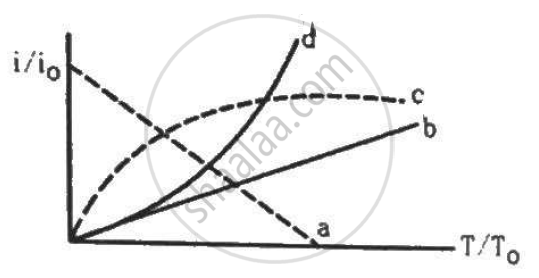
Let i0 be the thermionic current from a metal surface when the absolute temperature of the surface is T0. The temperature is slowly increased and the thermionic current is measured as a function of temperature. Which of the following plots may represent the variation in (i/i0) against (T/T0)?
The work function of aluminum is 4⋅2 eV. If two photons each of energy 2⋅5 eV are incident on its surface, will the emission of electrons take place? Justify your answer.
The wavelength λe of an electron and λp of a photon of same energy E are related by ______.
The wave associated with a moving particle of mass 3 × 10⁻⁶ g has the same wavelength as an electron moving with a velocity 6 × 10⁶ ms–1. The velocity of the particle is
Emission of electrons by the absorption of heat energy is called ____________ emission.
Define the work function of a metal. Give its unit.
In which case is electron emission from a metal not known?
Consider Figure for photoemission.

How would you reconcile with momentum conservation? Note light (photons) have momentum in a different direction than the emitted electrons.
What is responsible for electrical conduction in metals?
What prevents electrons from escaping a metal surface under ordinary conditions?
What is the work function (\[\phi_0\]) of a metal?
Under what condition does an electron escape after external energy is supplied?
What must fall on a metal surface for photoelectric emission to occur?
