Advertisements
Advertisements
प्रश्न
Why should gases be insulators at ordinary pressures and start conducting at very low pressures?
Advertisements
उत्तर
At atmospheric pressure, the ions of gases have no chance of reaching their respective electrons because of collision and recombination with other gas molecules. Hence, gases are insulators at atmospheric pressure. At low pressures, ions have a chance of reaching their respective electrodes and constitute a current. Hence, they conduct electricity at these pressures.
APPEARS IN
संबंधित प्रश्न
Find the (a) maximum frequency and (b) minimum wavelength of X-rays produced by 30 kV electrons.
Quarks inside protons and neutrons are thought to carry fractional charges [(+2/3)e; (–1/3)e]. Why do they not show up in Millikan’s oil-drop experiment?
The work function of the following metals is given : Na 2.75 ev, K = 2.3 eV, Mo = 4.17 eV and Ni = 5.15 eV. Which of these metals will not cause photoelectric emission for radiation of wavelength 3300 Å from a laser source placed 1 m away from these metals? What happens if the laser source is brought nearer and placed 50 cm away?
Would you prefer a material with a high melting point or a low melting point to be used as a cathode in a diode?
Why does thermionic emission not take place in non-conductors?
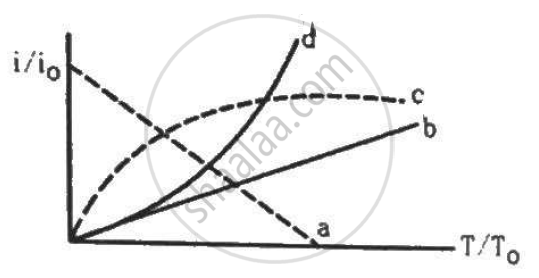
Let i0 be the thermionic current from a metal surface when the absolute temperature of the surface is T0. The temperature is slowly increased and the thermionic current is measured as a function of temperature. Which of the following plots may represent the variation in (i/i0) against (T/T0)?
The anode of a thermionic diode is connected to the negative terminal of a battery and the cathode to its positive terminal.
Define the term "Threshold frequency", in the context of photoelectric emission.
Photoelectric emission is observed from a metallic surface for frequencies ν1 and ν2 of the incident light (ν1 > ν2). If the maximum value of kinetic energy of the photoelectrons emitted in the two cases are in the ration 1 : n then the threshold frequency of the metallic surface is ______.
Consider Figure for photoemission.

How would you reconcile with momentum conservation? Note light (photons) have momentum in a different direction than the emitted electrons.
What is responsible for electrical conduction in metals?
What prevents electrons from escaping a metal surface under ordinary conditions?
In the boundary-wall analogy, what does the metal surface represent?
In the boundary-wall analogy, what is the minimum push needed for a free electron to jump over the wall and come out?
Which unit is used for the work function?
What is the value of \[1\,\mathrm{eV}\] in joules?
Under what condition does an electron escape after external energy is supplied?
What causes field emission?
