Advertisements
Advertisements
प्रश्न
Why do metals have a large number of free electrons?
Advertisements
उत्तर
In metals, the electrons in the outermost shells are loosely bound to the nucleus. Even at room temperature, there are a large number of free electrons which are moving inside the metal in a random manner.
APPEARS IN
संबंधित प्रश्न
Why should gases be insulators at ordinary pressures and start conducting at very low pressures?
How does one explain the emission of electrons from a photosensitive surface with the help of Einstein's photoelectric equation?
Would you prefer a material with a high melting point or a low melting point to be used as a cathode in a diode?
Why does thermionic emission not take place in non-conductors?
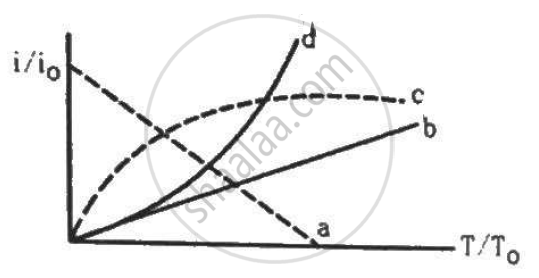
Let i0 be the thermionic current from a metal surface when the absolute temperature of the surface is T0. The temperature is slowly increased and the thermionic current is measured as a function of temperature. Which of the following plots may represent the variation in (i/i0) against (T/T0)?
What do you mean by electron emission? Explain briefly various methods of electron emission.
In the boundary-wall analogy, what is the minimum push needed for a free electron to jump over the wall and come out?
What is the work function (\[\phi_0\]) of a metal?
When do electrons escape from a heated metal in thermionic emission?
What must fall on a metal surface for photoelectric emission to occur?
