Advertisements
Advertisements
प्रश्न
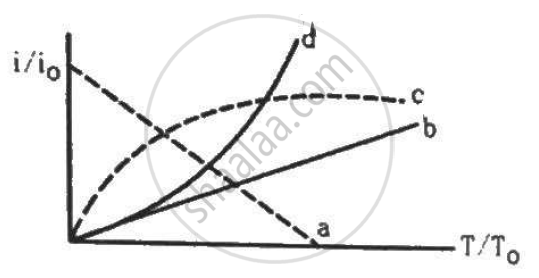
Let i0 be the thermionic current from a metal surface when the absolute temperature of the surface is T0. The temperature is slowly increased and the thermionic current is measured as a function of temperature. Which of the following plots may represent the variation in (i/i0) against (T/T0)?
विकल्प
a
b
c
d
Advertisements
उत्तर
d
Since the thermionic current is directly proportional to the square of the temperature of the surface emitting thermions, the graph is parabolic.
APPEARS IN
संबंधित प्रश्न
The work function of caesium metal is 2.14 eV. When light of frequency 6 × 10¹⁴ Hz is incident on the metal surface, photoemission of electrons occurs. What is the
- maximum kinetic energy of the emitted electrons,
- Stopping potential, and
- maximum speed of the emitted photoelectrons?
Why should gases be insulators at ordinary pressures and start conducting at very low pressures?
How will the thermionic current vary if the filament current is increased?
A diode value is connected to a battery and a load resistance. The filament is heated, so that a constant current is obtained in the circuit. As the cathode continuously emits electrons, does it become more and more positively charged?
Answer the following question.
Define the term "Threshold frequency", in the context of photoelectric emission.
Emission of electrons by the absorption of heat energy is called ____________ emission.
Why do metals have a large number of free electrons?
What do you mean by electron emission? Explain briefly various methods of electron emission.
In which case is electron emission from a metal not known?
What is electron emission?
Which particles at the surface hold free electrons inside the metal?
Under what condition does an electron escape after external energy is supplied?
Which are the three main ways electrons can be emitted from a metal surface?
What supplies energy to electrons in thermionic emission?
What is the order of the electric field required for field emission?
Which is an example of field emission?
What must fall on a metal surface for photoelectric emission to occur?
