Advertisements
Advertisements
प्रश्न
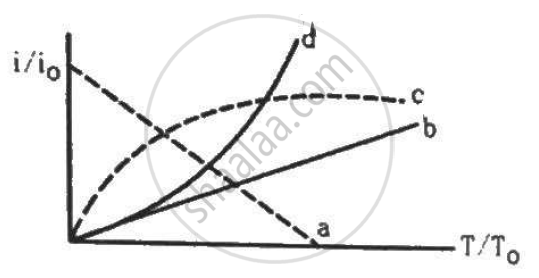
Let i0 be the thermionic current from a metal surface when the absolute temperature of the surface is T0. The temperature is slowly increased and the thermionic current is measured as a function of temperature. Which of the following plots may represent the variation in (i/i0) against (T/T0)?
पर्याय
a
b
c
d
Advertisements
उत्तर
d
Since the thermionic current is directly proportional to the square of the temperature of the surface emitting thermions, the graph is parabolic.
APPEARS IN
संबंधित प्रश्न
Find the maximum frequency of X-rays produced by 30 kV electrons.
Find the (a) maximum frequency and (b) minimum wavelength of X-rays produced by 30 kV electrons.
Why should gases be insulators at ordinary pressures and start conducting at very low pressures?
Would you prefer a material with a high melting point or a low melting point to be used as a cathode in a diode?
Would you prefer a material with a high work-function or a low work-function to be used as a cathode in a diode?
A diode value is connected to a battery and a load resistance. The filament is heated, so that a constant current is obtained in the circuit. As the cathode continuously emits electrons, does it become more and more positively charged?
Why does thermionic emission not take place in non-conductors?
Define the term "Threshold frequency", in the context of photoelectric emission.
Answer the following question.
Define the term "Threshold frequency", in the context of photoelectric emission.
The work function of aluminum is 4⋅2 eV. If two photons each of energy 2⋅5 eV are incident on its surface, will the emission of electrons take place? Justify your answer.
The wave associated with a moving particle of mass 3 × 10⁻⁶ g has the same wavelength as an electron moving with a velocity 6 × 10⁶ ms–1. The velocity of the particle is
If a light of wavelength 330 nm is incident on a metal with work function 3.55 eV, the electrons are emitted. Then the wavelength of the wave associated with the emitted electron is (Take h = 6.6 × 10⁻³⁴ Js)
Name the factors on which photoelectric emission from a surface depends.
The work function of a metal is 2.31 eV. Photoelectric emission occurs when the light of frequency 6.4 × 10¹⁴ Hz is incident on the metal surface. Calculate
- the energy of the incident radiation,
- the maximum kinetic energy of the emitted electron and
- the stopping potential of the surface.
What is responsible for electrical conduction in metals?
What prevents electrons from escaping a metal surface under ordinary conditions?
In the boundary-wall analogy, what does the metal surface represent?
In the boundary-wall analogy, what is the minimum push needed for a free electron to jump over the wall and come out?
What is the value of \[1\,\mathrm{eV}\] in joules?
What supplies energy to electrons in thermionic emission?
