Advertisements
Advertisements
प्रश्न
The wave associated with a moving particle of mass 3 × 10⁻⁶ g has the same wavelength as an electron moving with a velocity 6 × 10⁶ ms–1. The velocity of the particle is
पर्याय
1.82 × 10⁻¹⁸ ms–1
9 × 10⁻² ms–1
3 × 10–31 ms–1
1.82 × 10⁻¹⁵ ms–1
Advertisements
उत्तर
1.82 × 10⁻¹⁵ ms–1
APPEARS IN
संबंधित प्रश्न
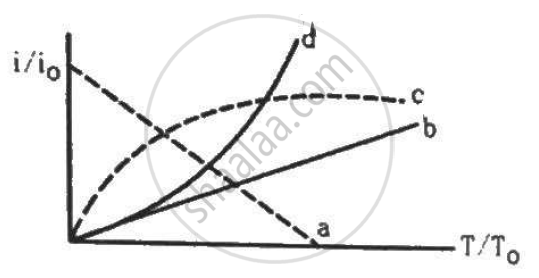
Let i0 be the thermionic current from a metal surface when the absolute temperature of the surface is T0. The temperature is slowly increased and the thermionic current is measured as a function of temperature. Which of the following plots may represent the variation in (i/i0) against (T/T0)?
The work function of aluminum is 4⋅2 eV. If two photons each of energy 2⋅5 eV are incident on its surface, will the emission of electrons take place? Justify your answer.
A 150 W lamp emits light of the mean wavelength of 5500 Å. If the efficiency is 12%, find out the number of photons emitted by the lamp in one second.
What is responsible for electrical conduction in metals?
What is electron emission?
Which unit is used for the work function?
What is the value of \[1\,\mathrm{eV}\] in joules?
What supplies energy to electrons in thermionic emission?
Which is an example of thermionic emission?
What is the order of the electric field required for field emission?
