Advertisements
Advertisements
प्रश्न
Answer the following question.
Define the term "Threshold frequency", in the context of photoelectric emission.
Define the term ‘threshold frequency’ for a photosensitive material.
Advertisements
उत्तर
For a given Photosensitive material, there is a certain minimum cut off frequency at which Photoelectric emission is possible is called Threshold frequency, i.e. At this frequency just emission of photoelectrons happens without giving them any kind of additional energy. Higher the work function of the material, greater is the Threshold frequency.
APPEARS IN
संबंधित प्रश्न
Quarks inside protons and neutrons are thought to carry fractional charges [(+2/3)e; (–1/3)e]. Why do they not show up in Millikan’s oil-drop experiment?
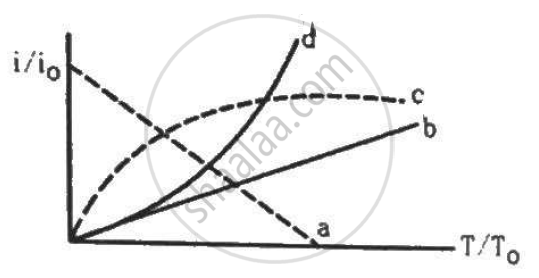
Let i0 be the thermionic current from a metal surface when the absolute temperature of the surface is T0. The temperature is slowly increased and the thermionic current is measured as a function of temperature. Which of the following plots may represent the variation in (i/i0) against (T/T0)?
The anode of a thermionic diode is connected to the negative terminal of a battery and the cathode to its positive terminal.
Define the term "Threshold frequency", in the context of photoelectric emission.
The work function of aluminum is 4⋅2 eV. If two photons each of energy 2⋅5 eV are incident on its surface, will the emission of electrons take place? Justify your answer.
If a light of wavelength 330 nm is incident on a metal with work function 3.55 eV, the electrons are emitted. Then the wavelength of the wave associated with the emitted electron is (Take h = 6.6 × 10⁻³⁴ Js)
What do you mean by electron emission? Explain briefly various methods of electron emission.
Name the factors on which photoelectric emission from a surface depends.
The work function of a metal is 2.31 eV. Photoelectric emission occurs when the light of frequency 6.4 × 10¹⁴ Hz is incident on the metal surface. Calculate
- the energy of the incident radiation,
- the maximum kinetic energy of the emitted electron and
- the stopping potential of the surface.
What is responsible for electrical conduction in metals?
