Advertisements
Advertisements
प्रश्न
The anode of a thermionic diode is connected to the negative terminal of a battery and the cathode to its positive terminal.
विकल्प
No appreciable current will pass through the diode.
A large current will pass through the diode from the anode to the cathode.
A large current will pass through the diode from the cathode to the anode.
The diode will be damaged.
Advertisements
उत्तर
No appreciable current will pass through the diode.
If the anode is given a negative potential relative to the cathode, the electrons are pushed back to the cathode. Hence, no current will flow through the diode.
APPEARS IN
संबंधित प्रश्न
Find the (a) maximum frequency and (b) minimum wavelength of X-rays produced by 30 kV electrons.
How does one explain the emission of electrons from a photosensitive surface with the help of Einstein's photoelectric equation?
Why does thermionic emission not take place in non-conductors?
Let i0 be the thermionic current from a metal surface when the absolute temperature of the surface is T0. The temperature is slowly increased and the thermionic current is measured as a function of temperature. Which of the following plots may represent the variation in (i/i0) against (T/T0)?
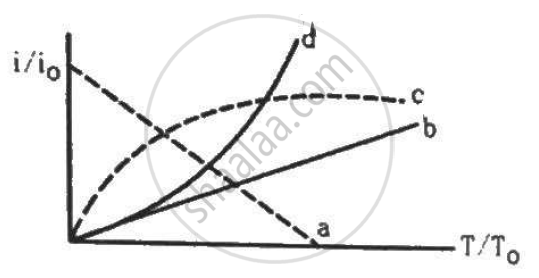
Answer the following question.
Define the term "Threshold frequency", in the context of photoelectric emission.
If a light of wavelength 330 nm is incident on a metal with work function 3.55 eV, the electrons are emitted. Then the wavelength of the wave associated with the emitted electron is (Take h = 6.6 × 10⁻³⁴ Js)
Photoelectric emission is observed from a metallic surface for frequencies ν1 and ν2 of the incident light (ν1 > ν2). If the maximum value of kinetic energy of the photoelectrons emitted in the two cases are in the ration 1 : n then the threshold frequency of the metallic surface is ______.
Name the factors on which photoelectric emission from a surface depends.
What prevents electrons from escaping a metal surface under ordinary conditions?
In the boundary-wall analogy, what does the metal surface represent?
In the boundary-wall analogy, what is the minimum push needed for a free electron to jump over the wall and come out?
What is the work function (\[\phi_0\]) of a metal?
What is the value of \[1\,\mathrm{eV}\] in joules?
What must supplied energy enable a metal electron to overcome for electron emission to occur?
Under what condition does an electron escape after external energy is supplied?
What supplies energy to electrons in thermionic emission?
Which is an example of thermionic emission?
Which is an example associated with photoelectric emission?
