Advertisements
Advertisements
Question
Why do metals have a large number of free electrons?
Advertisements
Solution
In metals, the electrons in the outermost shells are loosely bound to the nucleus. Even at room temperature, there are a large number of free electrons which are moving inside the metal in a random manner.
APPEARS IN
RELATED QUESTIONS
Why should gases be insulators at ordinary pressures and start conducting at very low pressures?
How will the thermionic current vary if the filament current is increased?
The cathode of a diode valve is replaced by another cathode of double the surface area. Keeping the voltage and temperature conditions the same, will the place current decrease, increase or remain the same?
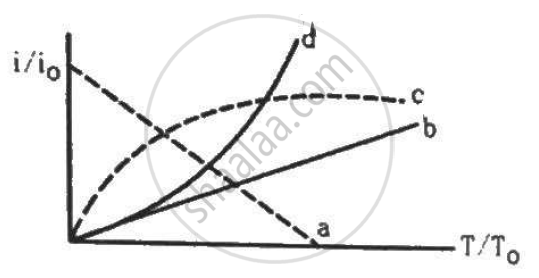
Let i0 be the thermionic current from a metal surface when the absolute temperature of the surface is T0. The temperature is slowly increased and the thermionic current is measured as a function of temperature. Which of the following plots may represent the variation in (i/i0) against (T/T0)?
The anode of a thermionic diode is connected to the negative terminal of a battery and the cathode to its positive terminal.
The wavelength λe of an electron and λp of a photon of same energy E are related by ______.
If a light of wavelength 330 nm is incident on a metal with work function 3.55 eV, the electrons are emitted. Then the wavelength of the wave associated with the emitted electron is (Take h = 6.6 × 10⁻³⁴ Js)
Emission of electrons by the absorption of heat energy is called ____________ emission.
Consider Figure for photoemission.

How would you reconcile with momentum conservation? Note light (photons) have momentum in a different direction than the emitted electrons.
Give an example each of a metal from which photoelectric emission takes place when irradiated by
- UV light
- visible light.
