Advertisements
Advertisements
Question
The constant A in the Richardson−Dushman equation for tungsten is 60 × 104 A m−2K−2. The work function of tungsten is 4.5 eV. A tungsten cathode with a surface area 2.0 × 10⁻⁵ m2 is heated by a 24 W electric heater. In steady state, the heat radiated by the heater and the cathode equals the energy input by the heater and the temperature becomes constant. Assuming that the cathode radiates like a blackbody, calculate the saturation current due to thermions. Take Stefan's Constant = 6 × 10⁻⁸ W m−2 K−1. Assume that the thermions take only a small fraction of the heat supplied.
Advertisements
Solution
Given:-
A = 60 × 104 A m−2 K−2
Work function of tungsten, ϕ = 4.5 eV
Stefan's Constant, σ = 6 × 10⁻⁸ W m−2 K−1
Surface area of tungsten cathode, S = 2.0 × 10⁻⁵ m2
Boltzmann's Constant, k = 1.38× 10⁻²³ J/K
Heat supplied by the heater, H = 24 W
The cathode acts as a black body; thus, its emissivity is 1.
According Stefan's Law:-
The power (P) radiated by a blackbody with surface area (A) and temperature (T),
\[P = \sigma A T^4 \]
\[ \Rightarrow T^4 = \frac{P}{\sigma A}\]
\[ \Rightarrow T^4 = \frac{24}{(6 \times {10}^{- 8} ) \times (2 \times {10}^{- 5} )}\]
\[ \Rightarrow T^4 = 2 \times {10}^{13} K = 20 \times {10}^{12} K\]
\[ \Rightarrow T = 2 . 1147 \times {10}^3 = 2114 . 7 K\]
According to the Richard-Dushmann equation, emission current,
\[i = AS T^2 e^{- \phi/KT} \]
\[i = 6 \times {10}^5 \times 2 \times {10}^{- 5} \times (2114 . 7 )^2 \times e^\frac{- 4 . 5 \times 1 . 6 \times {10}^{- 19}}{1 . 38 \times {10}^{- 23} \times 2114 . 7} \]
\[i = 1 . 03456 \times {10}^{- 3} A \approx 1 . 0\text{ mA}\]
APPEARS IN
RELATED QUESTIONS
Find the maximum frequency of X-rays produced by 30 kV electrons.
How does one explain the emission of electrons from a photosensitive surface with the help of Einstein's photoelectric equation?
How will the thermionic current vary if the filament current is increased?
Would you prefer a material with a high work-function or a low work-function to be used as a cathode in a diode?
The cathode of a diode valve is replaced by another cathode of double the surface area. Keeping the voltage and temperature conditions the same, will the place current decrease, increase or remain the same?
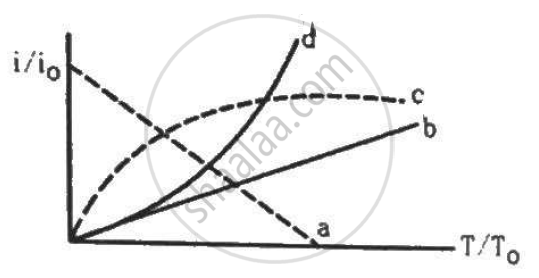
Let i0 be the thermionic current from a metal surface when the absolute temperature of the surface is T0. The temperature is slowly increased and the thermionic current is measured as a function of temperature. Which of the following plots may represent the variation in (i/i0) against (T/T0)?
The anode of a thermionic diode is connected to the negative terminal of a battery and the cathode to its positive terminal.
Answer the following question.
Define the term "Threshold frequency", in the context of photoelectric emission.
What do you mean by electron emission? Explain briefly various methods of electron emission.
Consider Figure for photoemission.

How would you reconcile with momentum conservation? Note light (photons) have momentum in a different direction than the emitted electrons.
What prevents electrons from escaping a metal surface under ordinary conditions?
What is electron emission?
Under what condition does an electron escape after external energy is supplied?
Which are the three main ways electrons can be emitted from a metal surface?
When do electrons escape from a heated metal in thermionic emission?
Which is an example of thermionic emission?
What is the order of the electric field required for field emission?
What must fall on a metal surface for photoelectric emission to occur?
