Advertisements
Advertisements
What happens to the other bulbs in a series circuit if one bulb blows off?
Concept: undefined >> undefined
What happens to the other bulbs in a parallel circuit if one bulb blows off?
Concept: undefined >> undefined
Advertisements
Which type of circuit, series or parallel, is preferred while connecting a large number of bulbs:
(a) for decorating a hotel building from outside?
Concept: undefined >> undefined
Which type of circuit, series or parallel, is preferred while connecting a large number of bulbs:
(b) for lighting inside the rooms of the hotel?
Concept: undefined >> undefined
Draw a circuit diagram to show how two 4 V electric lamps can be lit brightly from two 2 V cells.
Concept: undefined >> undefined
Give three reasons why different electrical appliances in a domestic circuit are connected in parallel.
Concept: undefined >> undefined
Ten bulbs are connected in a series circuit to a power supply line. Ten identical bulbs are connected in a parallel circuit to an identical power supply line.
- Which circuit would have the highest voltage across each bulb?
- In which circuit would the bulbs be brighter?
- In which circuit, if one bulb blows out, all others will stop glowing?
- Which circuit would have less current in it?
Concept: undefined >> undefined
Ten bulbs are connected in a series circuit to a power supply line. Ten identical bulbs are connected in a parallel circuit to an identical power supply line.
(b) In which circuit, if one bulbs be brighter?
Concept: undefined >> undefined
Ten bulbs are connected in a series circuit to a power supply line. Ten identical bulbs are connected in a parallel circuit to an identical power supply line.
(c) In which circuit, if one bulb blows out, all other will stop glowing?
Concept: undefined >> undefined
Ten bulbs are connected in a series circuit to a power supply line. Ten identical bulbs are connected in a parallel circuit to an identical power supply line.
(d) Which circuit would have less current in it?
Concept: undefined >> undefined
Consider the circuit given below:
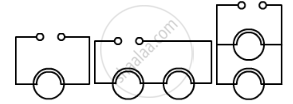
(a) In which circuit are the lamps dimmest?
(b) In which circuit or circuits are the lamps of equal brightness to the lamps in circuit (i)?
(c) Which circuit gives out the maximum light?
Concept: undefined >> undefined
If you were going to connect two light bulbs to one battery, would you use a series or a parallel arrangement? Why? Which arrangement takes more current from the battery?
Concept: undefined >> undefined
Which is the better way to connect lights and other electrical appliances in domestic wiring: series circuits or parallel circuits? why?
Concept: undefined >> undefined
Christmas tree lamps are usually wired in series. What happens if one lamps breaks?
Concept: undefined >> undefined
An electrician has wired a house in such a way that if a lamp gets fused in one room of the house, all the lamps in other rooms of the house stop working. What is the defect in the wiring?
Concept: undefined >> undefined
Draw a circuit diagram showing two electric lamps connected in parallel together with a cell and a switch that works both lamps. Mark an â’¶ on your diagram to show where an ammeter should be placed to measure the current.
Concept: undefined >> undefined
The lamps in a house hold circuit are connected in parallel because:
(a) this way they required less current
(b) if one lamp fails the others remain lit
(c) this way they require less power
(d) if one lamp fails the other also fail
Concept: undefined >> undefined
Using the circuit given below, state which of the following statement is correct?
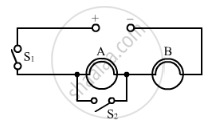
(a) When S1 and S2 are closed, lamps A and B are lit.22
(b) With S1 open and S2 closed, A is lit and B is not lit.
(c) With S2 open and S1 closed A and B are lit.
(d) With S1 closed and S2 open, lamp A remains lit even if lamp B gets fused.
Concept: undefined >> undefined
Draw a circuit diagram showing two lamps, one cell and a switch connected in series.
How can you change the brightness of the lamp?
Concept: undefined >> undefined
Consider the circuit given below when A, B and C are three identical light bulbs of constant resistance. 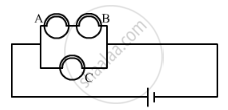
(a) List the bulbs in order of increasing brightness.
(b) If C burns out, what will be the brightness of A now compared with before?
(c) If B burns out instead, what will be the brightness of A and C compared with before?
Concept: undefined >> undefined
