Please select a subject first
Advertisements
Advertisements
Two copper wires are of the same length, but one is thicker than the other. Which wire will have more resistance?
Concept: Electric Resistance
(i) Two sets A and B, of three bulbs each, are glowing in two separate rooms. When one of the bulbs in set A is fused, the other two bulbs also cease to glow. But in set B, when one bulb fuses, the other two bulbs continue to glow. Explain why this phenomenon occurs.
(ii) Why do we prefer arrangements of Set B for house circuiting?
Concept: Resistance of a System of Resistors >> Resistors in Series
You have three resistors of values 2Ω, 3Ω and 5Ω. How will you join them so that the total resistance is more than 7Ω?
1) Draw a diagram for the arrangement
2) Calculate the equivalent resistance.
Concept: Potential and Potential Difference
Name two safety devices which are connected to the live wire of a household electric circuit
Concept: Electrical Power
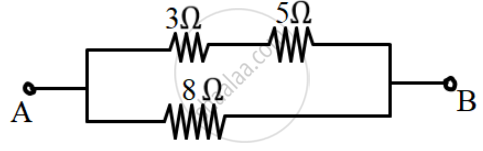
Find the equivalent resistance between A and B
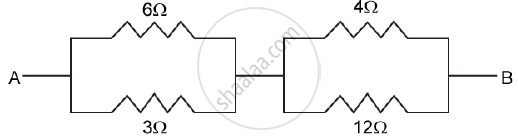
Concept: Resistance of a System of Resistors >> Resistors in Series
State whether the resistivity of a wire changes with the change in the thickness of the wire.
Concept: Potential and Potential Difference
How does an increase in the temperature affect the specific resistance of a :
(i) Metal and
(ii) Semiconductor ?
Concept: Ohm's Law
Calculate the effective resistance across AB?
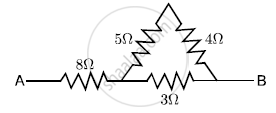
Concept: Ohm's Law
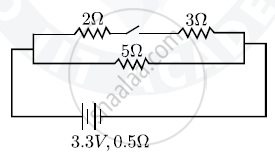
The diagram above shows a circuit with the key k open. Calculate :
(i) the resistance of the circuit when the key k is open.
(ii) the current drawn from the cell when the key k is open.
(iii) the resistance of the circuit when the key k is closed.
(iv) the current drawn from the cell when the key k is closed.
Concept: Electrical Power
The diagram below shows a magnetic kept just below the conductor AB which is kept in North South direction.
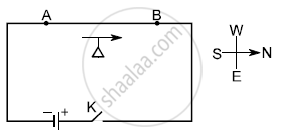
(i) In which direction will the needle deflect when the key is closed ?
(ii) Why is the deflection produced ?
(iii) What will be the change in the deflection if the magnetic needle is taken just above the conductor AB ?
(iv) Name one device which works on this principle.
Concept: Electrical Power
(a) Calculate the total resistance across AB.
(b) If a cell of e.m.f 2.4 V with negligible internal resistance is connected across AB then calculate the current drawn from the cell.
Concept: Internal Resistance of a Cell
(a) Observe the diagram given below and state whether the bulb will glow or not when we switch on K.
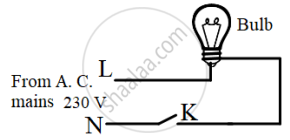
(b) Is it safe to handle the bulb when the switch is OFF?
(c) Give a reason for your answer in (b).
Concept: Heating Effect of Electric Current
An electric bulb is rated ‘240 V, 100 W’.
- What information can you get from the above statement?
- What will happen if this bulb is connected across 220 V?
- Calculate the resistance of the bulb.
- Also find the energy consumed by the bulb in 10 minutes.
Concept: Electric Resistance
When a current I flows through a wire of resistance R for time t then the electrical energy produced is given by ______.
Concept: Heating Effect of Electric Current
Choose the correct relation for e.m.f. (ε) and terminal voltage V:
Concept: Terminal Voltage of a Cell
'A geyser is rated 240 W-220 V'. Explain the meaning of this statement.
Concept: Power Rating of Common Electrical Appliances
Find the value of current I drawn from the cell.
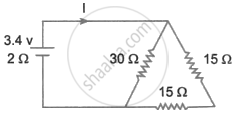
- Calculate the current I.
- Calculate the terminal voltage.
Concept: Terminal Voltage of a Cell
The potential difference between terminals of a cell in a closed electric circuit is ______.
Concept: Terminal Voltage of a Cell
