Advertisements
Advertisements
Question
Write the structure of the major organic product in the following reaction:
\[\ce{CH3CH2Br + KCN ->[aq{.} ethanol]}\]
Advertisements
Solution
\[\ce{\underset{Bromoethane}{CH3CH2Br} + KCN ->[aq{.} ethanol][(nucleophilic substitution)] \underset{Propanenitrile}{CH3CH2CN} + KBr}\]
APPEARS IN
RELATED QUESTIONS
Write the main products when methyl chloride is treated with AgCN.
Which would undergo SN2 reaction faster in the following pair and why ?

Write the structure of the major product in each of the following reaction :

Write the structures of A, B and C in the following:

In the following pair of halogen compounds, which compound undergoes a faster SN1 reaction?

Identify 'A' in the following reaction -

(a) 2- Bromo-2 methylbutane
(b) 1 -Bromo-2,2-dimethylpropane
(c) 1 - Bromo - 3 -methylbutane
(d) 1 - Bromo- 2 -methylpropane
What is the action of the following on ethyl bromide
alcoholic solution of potassium hydroxide.
Which one is most reactive towards SN1 reaction?
Tertiary alkyl halides are practically inert to substitution by SN2 mechanism because of ____________.
2-Bromopentane is heated with potassium ethoxide in ethanol. The major product obtained is ____________.
The increasing order of nucleophilicity would be:
Which of the following statements are correct about the kinetics of this reaction?

(i) The rate of reaction depends on the concentration of only (b).
(ii) The rate of reaction depends on concentration of both (a) and (b).
(iii) Molecularity of reaction is one.
(iv) Molecularity of reaction is two.
Ethylene chloride and ethylidene chloride are isomers. Identify the correct statements.
(i) Both the compounds form same product on treatment with alcoholic KOH.
(ii) Both the compounds form same product on treatment with aq.NaOH.
(iii) Both the compounds form same product on reduction.
(iv) Both the compounds are optically active.
Compound ‘A’ with molecular formula \[\ce{C4H9Br}\] is treated with aq. \[\ce{KOH}\] solution. The rate of this reaction depends upon the concentration of the compound ‘A’ only. When another optically active isomer ‘B’ of this compound was treated with aq. \[\ce{KOH}\] solution, the rate of reaction was found to be dependent on concentration of compound and \[\ce{KOH}\] both.
(i) Write down the structural formula of both compounds ‘A’ and ‘B’.
(ii) Out of these two compounds, which one will be converted to the product with inverted configuration.
Match the reactions given in Column I with the types of reactions given in Column II.
| Column I | Column II | |
| (i) | 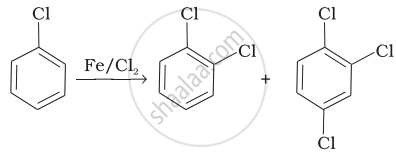 |
(a) Nucleophilic aromatic substitution |
| (ii) | \[\begin{array}{cc} \ce{CH3 - CH = CH2 + HBr -> CH3 - CH - CH3}\\ \phantom{............................}|\phantom{}\\ \phantom{.............................}\ce{Br}\phantom{} \end{array}\] |
(b) Electrophilic aromatic substitution |
| (iii) | 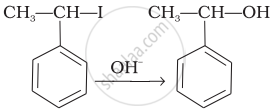 |
(c) Saytzeff elimination |
| (iv) | 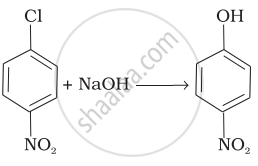 |
(d) Electrophilic addition |
| (v) | \[\begin{array}{cc} \ce{CH3 CH2 CH CH3 ->[alc.KOH] CH3 CH = CH CH3}\\ \phantom{}|\phantom{..........................}\\ \phantom{}\ce{Br}\phantom{........................} \end{array}\] |
(e) Nucleophilic substitution (SN1) |
Which of the following is the definition of chirality?
The number of chiral carbons present in the molecule given below is ______.

Arrange the following compounds in increasing order of reactivity towards SN2 reaction.
2-Bromopentane, 1-Bromopentane, 2-Bromo-2-methylbutane
Explain why Grignard reagents should be prepared under anhydrous conditions.
Which of the following is halogen exchange reaction?
