Advertisements
Advertisements
Question
Identify 'A' in the following reaction -

(a) 2- Bromo-2 methylbutane
(b) 1 -Bromo-2,2-dimethylpropane
(c) 1 - Bromo - 3 -methylbutane
(d) 1 - Bromo- 2 -methylpropane
Advertisements
Solution
1 -Bromo-2,2-dimethylpropane

APPEARS IN
RELATED QUESTIONS
Write the main products when methyl chloride is treated with AgCN.
Out of  , which is more reactive towards SN1 reaction and why?
Write the structure of the major product in each of the following reaction :

How will you bring about the following conversion?
Toluene to benzyl alcohol
The stability order for carbocation is _______.
(A) 2° > 3° > 1°
(B) 3° > 2° > 1°
(C) 3° > 1° > 2°
(D) 1° > 3° > 2°
What is the action of the following on ethyl bromide:
moist silver oxide
In a coordination entity of the type [PtCl2(en)2]2+ which isomer will show optical isomerism?
Which of the following pairs is/are correctly matched?
| Reaction | Product | |
| I | RX + AgCN | RNC |
| II | RX + KCN | RCN |
| III | RX + KNO2 | \[\begin{array}{cc} \phantom{.......}\ce{O}\\ \phantom{.....}/\\ \ce{R - N}\phantom{....}\\ \phantom{.....}\backslash\backslash\\ \phantom{.......}\ce{O} \end{array}\] |
| IV | RX + AgNO2 | \[\ce{R-O-N=O}\] |
The order of reactivity of the given haloalkanes towards nucleophile is:
Which among MeX, RCH2X, R2CHX and R3CX is most reactive towards SN2 reaction?
Among the following, the dissociation constant is highest for:
Which of the following compound will undergo racemisation when reacts with aq. KOH?
(i)

(ii)
CH3CH2CH2Cl
(iii)
\[\begin{array}{cc}
\ce{CH3}\phantom{..}\\
|\phantom{....}\\
\ce{CH3-CH-CH2Cl}
\end{array}\]
(iv)
\[\begin{array}{cc}
\phantom{..}\ce{H}\\
\phantom{..}|\\
\ce{CH3-C-Cl}\\
\phantom{..}|\\
\phantom{.....}\ce{C2H5}
\end{array}\]
The reaction of C6H5–CH=CH–CH3 with HBr produces:
Complete the following analogy:
Same molecular formula but different structures: A : : Non superimposable mirror images: B

Which of the statements are correct about above reaction?
(i) (a) and (e) both are nucleophiles.
(ii) In (c) carbon atom is sp3 hybridised.
(iii) In (c) carbon atom is sp2 hybridised.
(iv) (a) and (e) both are electrophiles.
Which of the following statements are correct about the kinetics of this reaction?

(i) The rate of reaction depends on the concentration of only (b).
(ii) The rate of reaction depends on concentration of both (a) and (b).
(iii) Molecularity of reaction is one.
(iv) Molecularity of reaction is two.
Which of the compounds will react faster in SN1 reaction with the –OH ion?
\[\ce{CH3-CH2-Cl}\] or \[\ce{C6H5-CH2-Cl}\]
Elimination reactions (especially β-elimination) are as common as the nucleophilic substitution reaction in case of alkyl halides. Specify the reagents used in both cases.
When CH3CH2CHCl2 is treated NaNH2 product formed is:-
The number of chiral carbons present in the molecule given below is ______.

The decreasing order of reactivity of the following compounds towards nucleophilic substitution (SN2) is ______.

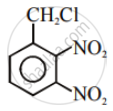

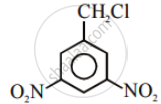
Retention of configuration is observed in ______.
Convert bromoethane to propanamine.
Discuss the mechanism of alkaline hydrolysis of methyl bromide.
Which one of the following chlorohydrocarbons readily undergoes solvolysis?
Consider the reactions,
(i) \[\begin{array}{cc}
\phantom{}\ce{\underset{}{(CH3)2CH - CH2Br} ->[C2H5OH] \underset{}{(CH3)2CH - CH2OC2H5 + HBr}}\\
\end{array}\]
(ii) \[\begin{array}{cc}
\phantom{}\ce{\underset{}{(CH3)2CH - CH2Br} ->[C2H5O-] \underset{}{(CH3)2CH - CH2OC2H5 + Br-}}\\
\end{array}\]
The mechanisms of reactions (i) and (ii) are respectively:
The correct order of increasing reactivity of
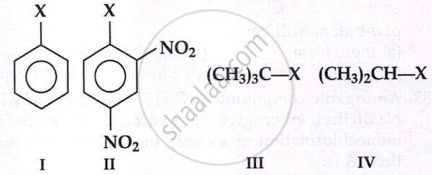
C-X bond towards nucleophile in the following compounds is:
The compound that will undergo SN1 reaction with the fastest rate is:
