Advertisements
Advertisements
Question
Elimination reactions (especially β-elimination) are as common as the nucleophilic substitution reaction in case of alkyl halides. Specify the reagents used in both cases.
Advertisements
Solution
Alkyl halides undergo nucleophilic substitution as well as elimination (Beta-elimination) reaction. However, by proper choice of reagents and reaction conditions, a particular product can be obtained. Usually strong and bulky bases and high temperature favour elimination reactions while weaker and smaller bases and lower temperature favour substitution reactions. For example, ethyl bromide on heating with alcoholic KOH (which contain stronger base, \[\ce{C2H5O}\] ion) at about 473-523 K undergoes elimination to give ethene. But with aqueous \[\ce{KOH}\] at about 373 K, it gives ethanol.
\[\ce{CH3CH2Br ->[alc.KOH][473-523 K] CH2 = CH2 (Elimination)}\]
\[\ce{CH3CH2Br ->[aq.KOH][373 K] CH3CH2OH (Substitution)}\]
Nucleophilic substitution: Reagents used nucleophilies like \[\ce{- \overset{-}{O}H, NH3, \overset{-}{C} ≡ N;, AgCN:, O = N - O, \overset{-}{O}R}\]' etc. also, alc. \[\ce{KOH}\] at lower temperature (373 K) undergoes substitution reaction.
APPEARS IN
RELATED QUESTIONS
Write the major products(s) in the following:

How do you convert the following:
Ethanol to propanenitrile
How will you bring about the following conversion?
Toluene to benzyl alcohol
The treatment of alkyl chlorides with aqueous KOH leads to the formation of alcohols but in the presence of alcoholic KOH, alkenes are major products. Explain.
What happens when methyl chloride is treated with KCN?
SN1 reactions are accompanied by racemization in optically active alkyl halides.
AgCN reacts with haloalkanes to form isocyanide. Haloalkanes react with KCN to form alkyl cyanides as the main product. Why?
Which of the following is optically inactive?
SN2 mechanism proceeds through intervention of ____________.
Which of the following undergoes nucleophilic substitution exclusively by SN1 mechanism?
Which of the following statements are correct about this reaction?

(i) The given reaction follows SN2 mechanism.
(ii) (b) and (d) have opposite configuration.
(iii) (b) and (d) have same configuration.
(iv) The given reaction follows SN1 mechanism.
Match the reactions given in Column I with the types of reactions given in Column II.
| Column I | Column II | |
| (i) | 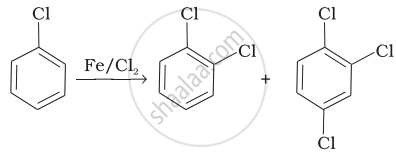 |
(a) Nucleophilic aromatic substitution |
| (ii) | \[\begin{array}{cc} \ce{CH3 - CH = CH2 + HBr -> CH3 - CH - CH3}\\ \phantom{............................}|\phantom{}\\ \phantom{.............................}\ce{Br}\phantom{} \end{array}\] |
(b) Electrophilic aromatic substitution |
| (iii) | 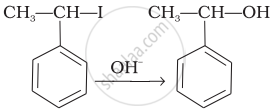 |
(c) Saytzeff elimination |
| (iv) | 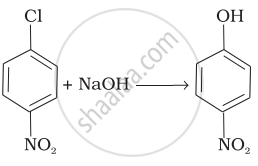 |
(d) Electrophilic addition |
| (v) | \[\begin{array}{cc} \ce{CH3 CH2 CH CH3 ->[alc.KOH] CH3 CH = CH CH3}\\ \phantom{}|\phantom{..........................}\\ \phantom{}\ce{Br}\phantom{........................} \end{array}\] |
(e) Nucleophilic substitution (SN1) |
Chlorination of alkanes is an example of
CCl4 is insoluble in water because:-
Optical activity of an enantiomeric mixture is +12.6° and the specific rotation of (+) isomer is +30°. The optical purity is ______ %.
Complete the reaction with the main product formed:

Give the mechanism of the following reaction:
\[\ce{CH3CH2OH ->[H2SO4][413 K] CH3CH2-O-CH2CH3 + H2O}\]
Assertion (A):  undergoes SN2 reactions faster than
  .
.
Reason (R): Iodine is a better leaving group because of its large size.
In the light of the above statements, choose the correct answer from the options given below:
