Advertisements
Advertisements
प्रश्न
Elimination reactions (especially β-elimination) are as common as the nucleophilic substitution reaction in case of alkyl halides. Specify the reagents used in both cases.
Advertisements
उत्तर
Alkyl halides undergo nucleophilic substitution as well as elimination (Beta-elimination) reaction. However, by proper choice of reagents and reaction conditions, a particular product can be obtained. Usually strong and bulky bases and high temperature favour elimination reactions while weaker and smaller bases and lower temperature favour substitution reactions. For example, ethyl bromide on heating with alcoholic KOH (which contain stronger base, \[\ce{C2H5O}\] ion) at about 473-523 K undergoes elimination to give ethene. But with aqueous \[\ce{KOH}\] at about 373 K, it gives ethanol.
\[\ce{CH3CH2Br ->[alc.KOH][473-523 K] CH2 = CH2 (Elimination)}\]
\[\ce{CH3CH2Br ->[aq.KOH][373 K] CH3CH2OH (Substitution)}\]
Nucleophilic substitution: Reagents used nucleophilies like \[\ce{- \overset{-}{O}H, NH3, \overset{-}{C} ≡ N;, AgCN:, O = N - O, \overset{-}{O}R}\]' etc. also, alc. \[\ce{KOH}\] at lower temperature (373 K) undergoes substitution reaction.
APPEARS IN
संबंधित प्रश्न
Which alkyl halide from the following pair would you expect to react more rapidly by an SN2 mechanism? Explain your answer.
CH3CH2CH2CH2Br or \[\begin{array}{cc}
\ce{CH3CH2CHCH3}\\
\phantom{.....}|\\
\phantom{.......}\ce{Br}\
\end{array}\]
Which compound in the following pair will react faster in SN2 reaction with OH−?
(CH3)3CCl or CH3Cl
Write the structure of the major organic product in the following reaction:
\[\ce{CH3CH2CH2OH + SOCl2 ->}\]
What is the action of the following on ethyl bromide:
moist silver oxide
Which of the following pairs is/are correctly matched?
| Reaction | Product | |
| I | RX + AgCN | RNC |
| II | RX + KCN | RCN |
| III | RX + KNO2 | \[\begin{array}{cc} \phantom{.......}\ce{O}\\ \phantom{.....}/\\ \ce{R - N}\phantom{....}\\ \phantom{.....}\backslash\backslash\\ \phantom{.......}\ce{O} \end{array}\] |
| IV | RX + AgNO2 | \[\ce{R-O-N=O}\] |
Which of the following compounds is optically active?
An organic molecule necessarily shows optical activity if it ____________.
Identify X and Y in the following sequence:
\[\ce{C2H5Br ->[X] Product ->[Y] C3H7NH2}\]
The correct order of increasing the reactivity of C–X bond towards nucleophile in following compounds.

(I)

(II)
(CH3)3CCl
(III)
(CH3)2CHCl
(IV)
Write the structures and names of the compounds formed when compound ‘A’ with molecular formula, \[\ce{C7H8}\] is treated with \[\ce{Cl2}\] in the presence of \[\ce{FeCl3}\].
Match the reactions given in Column I with the types of reactions given in Column II.
| Column I | Column II | |
| (i) | 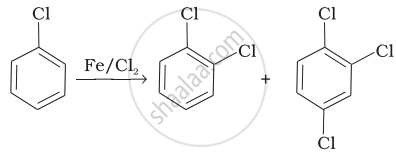 |
(a) Nucleophilic aromatic substitution |
| (ii) | \[\begin{array}{cc} \ce{CH3 - CH = CH2 + HBr -> CH3 - CH - CH3}\\ \phantom{............................}|\phantom{}\\ \phantom{.............................}\ce{Br}\phantom{} \end{array}\] |
(b) Electrophilic aromatic substitution |
| (iii) | 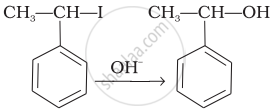 |
(c) Saytzeff elimination |
| (iv) | 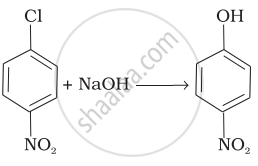 |
(d) Electrophilic addition |
| (v) | \[\begin{array}{cc} \ce{CH3 CH2 CH CH3 ->[alc.KOH] CH3 CH = CH CH3}\\ \phantom{}|\phantom{..........................}\\ \phantom{}\ce{Br}\phantom{........................} \end{array}\] |
(e) Nucleophilic substitution (SN1) |
Which of the following is the definition of chirality?
The number of chiral alcohol (s) with molecular formula C4H10O is ______.
Arrange the following compounds in increasing order of reactivity towards SN2 reaction.
2-Bromopentane, 1-Bromopentane, 2-Bromo-2-methylbutane
Inversion of configuration occurs in ______.
Give the mechanism of the following reaction:
\[\ce{CH3CH2OH ->[H2SO4][413 K] CH3CH2-O-CH2CH3 + H2O}\]
Identify the product in the following reaction: 
Discuss SN2 mechanism of methyl bromide using aqueous KOH.
