Advertisements
Advertisements
प्रश्न
The stability order for carbocation is _______.
(A) 2° > 3° > 1°
(B) 3° > 2° > 1°
(C) 3° > 1° > 2°
(D) 1° > 3° > 2°
Advertisements
उत्तर
(B) 3° > 2° > 1°
APPEARS IN
संबंधित प्रश्न
Write the structure of an isomer of compound C4H9Br which is most reactive towards SN1 reaction
Write the mechanism of the following reaction:
\[\ce{{n}BuBr + KCN ->[EtOH-H2O] {n}BuCN}\]
The treatment of alkyl chlorides with aqueous KOH leads to the formation of alcohols but in the presence of alcoholic KOH, alkenes are major products. Explain.
What happens when methyl chloride is treated with KCN?
How the following conversion can be carried out?
Ethyl chloride to propanoic acid.
Given reasons: SN1 reactions are accompanied by racemization in optically active alkyl halides.
What is the action of the following on ethyl bromide:
moist silver oxide
Answer the following question.
Write one stereochemical difference between SN1 and SN2 reactions.
AgCN reacts with haloalkanes to form isocyanide. Haloalkanes react with KCN to form alkyl cyanides as the main product. Why?
In the reaction, \[\ce{R - X + NaOR' -> ROR’ + X}\] ( – ve ion). The main product formed is:
Which of the following is optically inactive?
The process of separation of a racemic modification into d and l-enantiomers is called ____________.
Which of the following compounds is optically active?
Among the following, the dissociation constant is highest for:
Identify X and Y in the following sequence:
\[\ce{C2H5Br ->[X] Product ->[Y] C3H7NH2}\]
Which of the following undergoes nucleophilic substitution exclusively by SN1 mechanism?
Which of the following alkyl halides will undergo SN1 reaction most readily?
Which of the following compounds will give a racemic mixture on nucleophilic substitution by OH ion?
1-Bromoethane, 1-Bromopropane, 1-Bromobutane, Bromobenzene
Which of the following statements are correct about this reaction?

(i) The given reaction follows SN2 mechanism.
(ii) (b) and (d) have opposite configuration.
(iii) (b) and (d) have same configuration.
(iv) The given reaction follows SN1 mechanism.
Which of the following is the definition of chirality?
Which one of the following compounds is more reactive towards SN1 reaction?
Give reason for the following:
The product formed during SN1 reaction is a racemic mixture.
In which reaction mechanism carbocation is formed?
The number of chiral alcohol (s) with molecular formula C4H10O is ______.
The number of chiral carbons present in the molecule given below is ______.

Racemisation occurs in ______.
Acetic anhydride from acetic acid
Which alkyl halide from the following pair would you expect to react more rapidly by an SN2 mechanism? Explain your answer.
\[\begin{array}{cc}
\ce{CH3CHCH2CH2Br}\\
|\phantom{.............}\\
\ce{CH3}\phantom{..........}\\
\end{array}\] or \[\begin{array}{cc}
\ce{CH3CH2CHCH2Br}\\
|\\
\phantom{...}\ce{CH3}\\
\end{array}\]
The correct order of increasing reactivity of
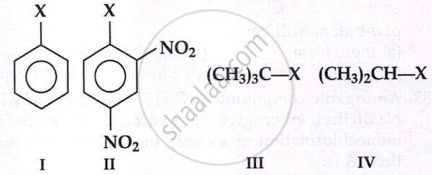
C-X bond towards nucleophile in the following compounds is:
