Advertisements
Advertisements
प्रश्न
The stability order for carbocation is _______.
(A) 2° > 3° > 1°
(B) 3° > 2° > 1°
(C) 3° > 1° > 2°
(D) 1° > 3° > 2°
Advertisements
उत्तर
(B) 3° > 2° > 1°
APPEARS IN
संबंधित प्रश्न
Write the structures of A, B and C in the following:

In the following pair of halogen compounds, which compound undergoes a faster SN1 reaction?

Which compound in the following pair will react faster in SN2 reaction with OH−?
CH3Br or CH3I
Which compound in the following pair will react faster in SN2 reaction with OH−?
(CH3)3CCl or CH3Cl
How will you bring about the following conversion?
Toluene to benzyl alcohol
Write the mechanism of the following reaction:
\[\ce{{n}BuBr + KCN ->[EtOH-H2O] {n}BuCN}\]
What happens when methyl chloride is treated with KCN?
How the following conversion can be carried out?
Ethyl chloride to propanoic acid.
SN1 reactions are accompanied by racemization in optically active alkyl halides.
Which of the following is optically inactive?
Tertiary alkyl halides are practically inert to substitution by SN2 mechanism because of ____________.
SN1 reaction of alkyl halides lead to ___________.
Which of the following compound will undergo racemisation when reacts with aq. KOH?
(i)

(ii)
CH3CH2CH2Cl
(iii)
\[\begin{array}{cc}
\ce{CH3}\phantom{..}\\
|\phantom{....}\\
\ce{CH3-CH-CH2Cl}
\end{array}\]
(iv)
\[\begin{array}{cc}
\phantom{..}\ce{H}\\
\phantom{..}|\\
\ce{CH3-C-Cl}\\
\phantom{..}|\\
\phantom{.....}\ce{C2H5}
\end{array}\]
The reaction of C6H5–CH=CH–CH3 with HBr produces:
Assertion: KCN reacts with methyl chloride to give methyl isocyanide.
Reason: CN– is an ambident nucleophile.
A primary alkyl halide would prefer to undergo ______.
Ethylene chloride and ethylidene chloride are isomers. Identify the correct statements.
(i) Both the compounds form same product on treatment with alcoholic KOH.
(ii) Both the compounds form same product on treatment with aq.NaOH.
(iii) Both the compounds form same product on reduction.
(iv) Both the compounds are optically active.
Which of the compounds will react faster in SN1 reaction with the –OH ion?
\[\ce{CH3-CH2-Cl}\] or \[\ce{C6H5-CH2-Cl}\]
Aryl halides are extremely less reactive towards nucleophilic substitution. Predict and explain the order of reactivity of the following compounds towards nucleophilic substitution:
| (I) |  |
| (II) |  |
| (III) |  |
Give reason for the following:
The product formed during SN1 reaction is a racemic mixture.
The number of chiral carbons present in the molecule given below is ______.

Identify the product in the following reaction: 
Discuss SN2 mechanism of methyl bromide using aqueous KOH.
Acetic anhydride from acetic acid
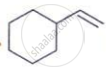 HCI, Major product ______.
The correct order of increasing reactivity of
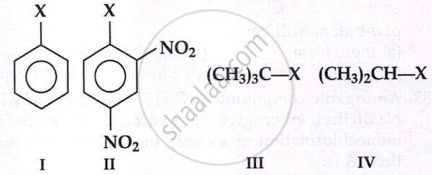
C-X bond towards nucleophile in the following compounds is:
