Advertisements
Advertisements
प्रश्न
Out of C6H5CH2Cl and C6H5CHClC6H5, which is more easily hydrolysed by aqueous KOH.
Advertisements
उत्तर
C6H5CHClC6H5 is hydrolysed faster.
- The hydrolysis of an alkyl halide is a nucleophilic substitution reaction. For aryl halides, this occurs through the SN1 method, resulting in a carbocation.
- C6H5CH2Cl or benzyl chloride gives
 a carbocation, while C6H5CHClC6H5 generates
 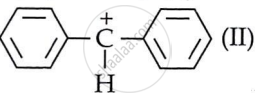 .
. - Out of I and II, carbocation II is more stable. Two attached phenyl rings on the carbon carry the positive charge.
- This leads to increased delocalisation of the positive charge and greater carbocation stability. This leads to faster formation of (II) and easier hydrolysis of the resulting halide than benzyl chloride.
APPEARS IN
संबंधित प्रश्न
Write the isomers of the compound having the formula C4H9Br.
What is the action of the following on ethyl bromide:
moist silver oxide
Which of the following is a primary halide?
Which one is most reactive towards SN1 reaction?
Which one of the following halogen compounds is difficult to be hydrolysed by SN1 mechanism?
Most reactive halide towards SN1 reaction is ____________.
Tertiary alkyl halides are practically inert to substitution by SN2 mechanism because of ____________.
Racemic compound has ____________.
Which of the following is a chiral compound?
SN1 reaction of alkyl halides lead to ___________.
Complete the following analogy:
Same molecular formula but different structures: A : : Non superimposable mirror images: B
Which of the following statements are correct about the kinetics of this reaction?

(i) The rate of reaction depends on the concentration of only (b).
(ii) The rate of reaction depends on concentration of both (a) and (b).
(iii) Molecularity of reaction is one.
(iv) Molecularity of reaction is two.
Why are aryl halides less reactive towards nucleophilic substitution reactions than alkyl halides?
Which of the following compounds will show retention in configuration on nucleophile substitution by OH− ion?
The number of chiral carbons present in the molecule given below is ______.

In SN1 reactions, the correct order of reactivity for the following compounds:
CH3Cl, CH3CH2Cl, (CH3)2CHCl and (CH3)3CCl is ______.
Racemisation occurs in ______.
Arrange the following compounds in increasing order of reactivity towards SN2 reaction.
2-Bromopentane, 1-Bromopentane, 2-Bromo-2-methylbutane
Acetic anhydride from acetic acid
Consider the reactions,
(i) \[\begin{array}{cc}
\phantom{}\ce{\underset{}{(CH3)2CH - CH2Br} ->[C2H5OH] \underset{}{(CH3)2CH - CH2OC2H5 + HBr}}\\
\end{array}\]
(ii) \[\begin{array}{cc}
\phantom{}\ce{\underset{}{(CH3)2CH - CH2Br} ->[C2H5O-] \underset{}{(CH3)2CH - CH2OC2H5 + Br-}}\\
\end{array}\]
The mechanisms of reactions (i) and (ii) are respectively:
