Advertisements
Advertisements
Question
Out of C6H5CH2Cl and C6H5CHClC6H5, which is more easily hydrolysed by aqueous KOH.
Advertisements
Solution
C6H5CHClC6H5 is hydrolysed faster.
- The hydrolysis of an alkyl halide is a nucleophilic substitution reaction. For aryl halides, this occurs through the SN1 method, resulting in a carbocation.
- C6H5CH2Cl or benzyl chloride gives
 a carbocation, while C6H5CHClC6H5 generates
 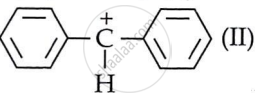 .
. - Out of I and II, carbocation II is more stable. Two attached phenyl rings on the carbon carry the positive charge.
- This leads to increased delocalisation of the positive charge and greater carbocation stability. This leads to faster formation of (II) and easier hydrolysis of the resulting halide than benzyl chloride.
APPEARS IN
RELATED QUESTIONS
Discuss the mechanism of alkaline hydrolysis of bromomethane.
Which would undergo SN1 reaction faster in the following pair and why?

Which compound in the following pair will react faster in SN2 reaction with OH−?
(CH3)3CCl or CH3Cl
Write the structure of the major organic product in the following reaction:
\[\ce{CH3CH2CH2OH + SOCl2 ->}\]
What happens when methyl chloride is treated with KCN?
In the reaction, \[\ce{R - X + NaOR' -> ROR’ + X}\] ( – ve ion). The main product formed is:
Which of the following is a primary halide?
Which of the following reactions is an example of nucleophilic substitution reaction?
Among the following, the dissociation constant is highest for:
A primary alkyl halide would prefer to undergo ______.
Compound ‘A’ with molecular formula \[\ce{C4H9Br}\] is treated with aq. \[\ce{KOH}\] solution. The rate of this reaction depends upon the concentration of the compound ‘A’ only. When another optically active isomer ‘B’ of this compound was treated with aq. \[\ce{KOH}\] solution, the rate of reaction was found to be dependent on concentration of compound and \[\ce{KOH}\] both.
(i) Write down the structural formula of both compounds ‘A’ and ‘B’.
(ii) Out of these two compounds, which one will be converted to the product with inverted configuration.
Elimination reactions (especially β-elimination) are as common as the nucleophilic substitution reaction in case of alkyl halides. Specify the reagents used in both cases.
Which one of the following compounds is more reactive towards SN1 reaction?
The major product formed in the following reaction is:

In SN1 reactions, the correct order of reactivity for the following compounds:
CH3Cl, CH3CH2Cl, (CH3)2CHCl and (CH3)3CCl is ______.
Give the mechanism of the following reaction:
\[\ce{CH3CH2OH ->[H2SO4][413 K] CH3CH2-O-CH2CH3 + H2O}\]
Which one of the following chlorohydrocarbons readily undergoes solvolysis?
The correct order of increasing reactivity of
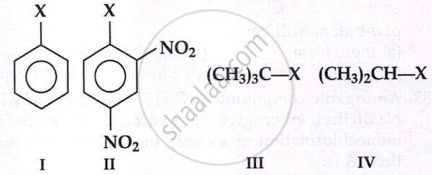
C-X bond towards nucleophile in the following compounds is:
The compound that will undergo SN1 reaction with the fastest rate is:
