Advertisements
Advertisements
Question
Write the structures and names of the compounds formed when compound ‘A’ with molecular formula, \[\ce{C7H8}\] is treated with \[\ce{Cl2}\] in the presence of \[\ce{FeCl3}\].
Advertisements
Solution
The compound with molecular formula \[\ce{C7H8}\] is toluene, \[\ce{C6H5CH3}\]. Since \[\ce{^-CH3}\] group is o-, p-directing, therefore, chlorination of toluene gives o-chlorotoluene and p-chlorotoluene, in which the p-isomer predominates.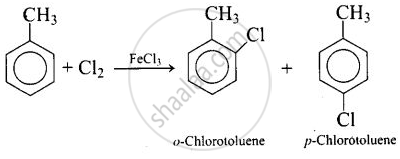
APPEARS IN
RELATED QUESTIONS
Write the main products when methyl chloride is treated with AgCN.
Which would undergo SN2 reaction faster in the following pair and why ?

Write the structures of A, B and C in the following:

Write the isomers of the compound having the formula C4H9Br.
What are ambident nucleophiles? Explain with an example.
Which compound in the following pair will react faster in SN2 reaction with OH−?
(CH3)3CCl or CH3Cl
Arrange the compounds of the following set in order of reactivity towards SN2 displacement:
1-Bromo-3-methylbutane, 2-Bromo-2-methylbutane, 2-Bromo-3-methylbutane
What happens when ethyl chloride is treated with aqueous KOH?
C–Cl bond length in chlorobenzene is shorter than C–Cl bond length in CH3–Cl.
Which of the following is an example of SN2 reaction?
Halogenation of alkanes is ____________.
Which of the following reactions is an example of nucleophilic substitution reaction?
Among the following, the dissociation constant is highest for:
Which of the following statements are correct about the kinetics of this reaction?

(i) The rate of reaction depends on the concentration of only (b).
(ii) The rate of reaction depends on concentration of both (a) and (b).
(iii) Molecularity of reaction is one.
(iv) Molecularity of reaction is two.
Elimination reactions (especially β-elimination) are as common as the nucleophilic substitution reaction in case of alkyl halides. Specify the reagents used in both cases.
Which of the following is the definition of chirality?
Which one is the correct order of nucleophilic strength (pKa) of following nucleophiles?
In which reaction mechanism carbocation is formed?
Complete the reaction with the main product formed:

Acetic anhydride from acetic acid
