Advertisements
Advertisements
Question
Compound ‘A’ with molecular formula \[\ce{C4H9Br}\] is treated with aq. \[\ce{KOH}\] solution. The rate of this reaction depends upon the concentration of the compound ‘A’ only. When another optically active isomer ‘B’ of this compound was treated with aq. \[\ce{KOH}\] solution, the rate of reaction was found to be dependent on concentration of compound and \[\ce{KOH}\] both.
(i) Write down the structural formula of both compounds ‘A’ and ‘B’.
(ii) Out of these two compounds, which one will be converted to the product with inverted configuration.
Advertisements
Solution
(i) The molecular formulae of isomers of \[\ce{C4H9Br}\] are \[\ce{CH3}\]
\[\begin{array}{cc}
\ce{CH3}\phantom{......}\\
|\phantom{.........}\\
\ce{CH3 - C - Br}\phantom{...........}\\
|\phantom{.........}\\
\ce{\underset{2 - Bromo-2-methyl propane (A)}{CH3}}\phantom{......}
\end{array}\]
\[\begin{array}{cc}
\ce{CH3 - CH2 - CH - CH3}\\
\phantom{.....}|\phantom{}\\
\phantom{.......}\ce{\underset{2-Bromobutance (B)}{Br}}\phantom{}
\end{array}\]
Since the rate of reaction of compound ‘A’ \[\ce{(C4H9Br)}\] with aqueous \[\ce{KOH}\] depends upon the concentration of compound ‘A’ only, therefore, the reaction occurs by SN1 mechanism and compound ‘A’ is tertiary bromide i.e., 2-Bromo-2-methylpropane.
\[\ce{(CH3)3CBr + KOH(aq) –> (CH3)3COH + KBr}\]
Rate = \[\ce{A:[(CH3)3CBr]}\]
(ii) Since compound ‘B’ is optically active and is an isomer of compound ‘A’ \[\ce{(C4H9Br)}\], therefore, compound ‘B’ must be 2-Bromobutane. Since the rate of reaction of compound ‘B’ with aqueous \[\ce{KOH}\] depends upon the concentration of compound ‘B’ and \[\ce{KOH}\], therefore, the reaction occurs by SN2 mechanism and product of hydrolysis will have inverted configuration.
\[\begin{array}{cc}
\ce{CH3CH2CHCH3 + KOH -> CH3CH2CHCH3 + KBr}\\
\phantom{..}|\phantom{...............................}|\phantom{...}\\
\phantom{..}\ce{Br}\phantom{.............................}\ce{OH}\phantom{.}
\end{array}\]
Rate = 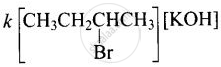
APPEARS IN
RELATED QUESTIONS
Discuss the mechanism of alkaline hydrolysis of bromomethane.
Give reasons for the following:
(CH3)3C–O–CH3 on reaction with HI gives (CH3)3C–I and CH3–OH as the main products and not (CH3)3C–OH and CH3–I.
Which compound in the following pair will react faster in SN2 reaction with OH−?
CH3Br or CH3I
Which compound in the following pair will react faster in SN2 reaction with OH−?
(CH3)3CCl or CH3Cl
Write the structure of the major organic product in the following reaction:
\[\ce{CH3CH2CH2OH + SOCl2 ->}\]
In a coordination entity of the type [PtCl2(en)2]2+ which isomer will show optical isomerism?
Which of the following is a primary halide?
Optically active isomers but not mirror images are called ____________.
Which of the following compounds is optically active?
2-Bromopentane is heated with potassium ethoxide in ethanol. The major product obtained is ____________.
Assertion: KCN reacts with methyl chloride to give methyl isocyanide.
Reason: CN– is an ambident nucleophile.
Which of the following statements are correct about the kinetics of this reaction?

(i) The rate of reaction depends on the concentration of only (b).
(ii) The rate of reaction depends on concentration of both (a) and (b).
(iii) Molecularity of reaction is one.
(iv) Molecularity of reaction is two.
Aryl halides are extremely less reactive towards nucleophilic substitution. Predict and explain the order of reactivity of the following compounds towards nucleophilic substitution:
| (I) |  |
| (II) |  |
| (III) |  |
Cyanide ion acts as an ambident nucleophile. From which end it acts as a stronger nucleophile in aqueous medium? Give reason for your answer.
In SN1 reactions, the correct order of reactivity for the following compounds:
CH3Cl, CH3CH2Cl, (CH3)2CHCl and (CH3)3CCl is ______.
Retention of configuration is observed in ______.
Identify the product in the following reaction: 
Which of the following reactions is an example of nucleophilic substitution reaction?
Assertion (A):  undergoes SN2 reactions faster than
  .
.
Reason (R): Iodine is a better leaving group because of its large size.
In the light of the above statements, choose the correct answer from the options given below:
