English
Karnataka Board PUCPUC Science 2nd PUC Class 12

Write the structure of the major organic product in the following reaction: CH3CH2CH2OH + SOCl2 ->

Advertisements
Advertisements

Question

Write the structure of the major organic product in the following reaction:

\[\ce{CH3CH2CH2OH + SOCl2 ->}\]

Chemical Equations/Structures
Advertisements

Solution

\[\ce{\underset{Propan-1-ol}{CH3CH2CH2OH} + SOCl2 ->[nucleophilic substitution] \underset{1-Chloropropane}{CH3CH2CH2Cl} + HCl\uparrow + SO2\uparrow}\]

shaalaa.com
  Is there an error in this question or solution?
Chapter 6: Haloalkanes and Haloarenes - Exercises [Page 190]

APPEARS IN

NCERT Chemistry Part 1 and 2 [English] Class 12
Chapter 6 Haloalkanes and Haloarenes
Exercises | Q 6.14 (vi) | Page 190

RELATED QUESTIONS

In the following pair of halogen compounds, which compound undergoes a faster SN1 reaction?


Which compound in the following pair will react faster in SN2 reaction with OH?

(CH3)3CCl or CH3Cl


Given reasons: SN1 reactions are accompanied by racemization in optically active alkyl halides.


Which would undergo SN2 reaction faster in the following pair and why ?

CH3 – CH2 ​– Br and CH3 ​– CH2 ​– I


What is the action of the following on ethyl bromide
alcoholic solution of potassium hydroxide.


What is the action of the following on ethyl bromide?

moist silver oxide


In a coordination entity of the type [PtCl2(en)2]2+ which isomer will show optical isomerism?


Which one is most reactive towards SN1 reaction?


SN2 mechanism proceeds through intervention of ____________.


Which of the following is the correct order of decreasing SN2 reactivity?


The process of separation of a racemic modification into d and l-enantiomers is called ____________.


Among the following, the dissociation constant is highest for:


Which of the following statements are correct about the kinetics of this reaction?

(i) The rate of reaction depends on the concentration of only (b).

(ii) The rate of reaction depends on concentration of both (a) and (b).

(iii) Molecularity of reaction is one.

(iv) Molecularity of reaction is two.


Ethylene chloride and ethylidene chloride are isomers. Identify the correct statements.

(i) Both the compounds form same product on treatment with alcoholic KOH.

(ii) Both the compounds form same product on treatment with aq.NaOH.

(iii) Both the compounds form same product on reduction.

(iv) Both the compounds are optically active.


In which reaction mechanism carbocation is formed?


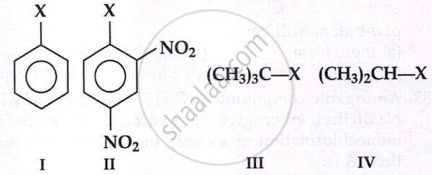
Among the following compounds I - IV, which one forms a yellow precipitate on reacting sequentially with (i) NaOH (ii) dil. HNO3 (iii) AgNO3?

I II III IV

Which of the following compounds will show retention in configuration on nucleophile substitution by OH ion?


The following questions are case-based questions. Read the passage carefully and answer the questions that follow:

Nucleophilic Substitution:
Nucleophilic substitution reaction of haloalkane can be conducted according to both SN1 and SN2 mechanisms. SN1 is a two-step reaction, while SN2 is a single-step reaction. For any haloalkane, which mechanism is followed depends on factors such as the structure of haloalkane, properties of leaving group, nucleophilic reagent and solvent.

Influences of solvent polarity:
In SN1 reaction, the polarity of the system increases from the reactant to the transition state, because a polar solvent has a greater effect on the transition state than the reactant, thereby reducing activation energy and accelerating the reaction. In SN2 reaction, the polarity of the system generally does not change from the reactant to the transition state, and only charge dispersion occurs. At this time, the polar solvent has a great stabilizing effect on Nu than the transition state, thereby increasing activation energy and slow down the reaction rate. For example, the decomposition rate (SN1) of tertiary chlorobutane at 25°C in water (dielectric constant 79) is 300000 times faster than in ethanol (dielectric constant 24).

The reaction rate (SN2) of 2-bromopropane and NaOH in ethanol containing 40% water is twice slower than in absolute ethanol. Hence the level of solvent polarity has an influence on both SN1 and SN2 reactions but with different results. Generally speaking, a weak polar solvent is favourable for SN2 reaction, while a strong polar solvent is favourable for SN1. Generally speaking, the substitution reaction of tertiary haloalkane is based on SN1 mechanism in solvents with a strong polarity (for example ethanol containing water).

Answer the following questions:

(a) Why racemisation occurs in SN1? (1)

(b) Why is ethanol less polar than water? (1)

(c) Which one of, the following in each pair is more reactive towards SN2 reaction? (2)

(i) CH3 – CH2 – I or CH3CH2 – Cl

(ii)

OR

(c) Arrange the following in the increasing order of their reactivity towards SN1 reactions: (2)

(i) 2-Bromo-2-methylbutane, 1-Bromo-pentane, 2-Bromo-pentane

(ii) 1-Bromo-3-methylbutane, 2-Bromo-2-methylbutane, 2-Bromo-3- methylbutane


Discuss SN2 mechanism of methyl bromide using aqueous KOH.


Share
Notifications

Englishहिंदीमराठी


      Forgot password?
Use app×