Advertisements
Advertisements
Question
Arrange the compounds of the following set in order of reactivity towards SN2 displacement:
1-Bromobutane, 1-Bromo-2, 2-dimethylpropane, 1-Bromo-2-methylbutane, 1-Bromo-3-methylbutane
Advertisements
Solution
The SN2 reaction involves the formation of a transition state with the carbon atom surrounded by 5 additional atoms (groups). A transition state requires minimal steric interactions. The most suitable substrates for SN2 reactions are 1° alkyl halides, followed by 2° and 3° alkyl halides. The order of reactivity towards SN2 is 1° > 2° > 3° > aryl halide. Based on this, the order will be:
\[\begin{array}{cc}
\phantom{................................................................................................}\ce{CH3}\phantom{..............................}\ce{CH3}\\
\phantom{............................................................................................}|\phantom{....................................}|\\
\ce{\underset{1-Bromobutane}{CH3(CH2)CH2Br} > \ce{\underset{1-Bromo-3-methylbutane}{(CH3)2 - CH - CH2 - CH2Br} > \ce{\underset{1-Bromo-2-methylbutane}{CH3 - CH2 - CH - CH2Br} > \ce{CH3 - C - CH2Br}}}}\\
\phantom{.................................................................................................................................}|\\
\phantom{.....................................................................................................................................}\ce{\underset{1-Bromo-2, 2-dimethylpropane}{CH3}}\
\end{array}\]
Although all alkyl halides are 1°, the order of reactivity depends on the steric barrier around the carbon bearing the –Br atom. The more bulky groups around a carbon, the lower its reactivity towards SN2.
APPEARS IN
RELATED QUESTIONS
Write the structure of an isomer of compound C4H9Br which is most reactive towards SN1 reaction
Write the major products(s) in the following:

In the following pair of halogen compounds, which compound undergoes a faster SN1 reaction?

Arrange the compounds of the following set in order of reactivity towards SN2 displacement:
1-Bromo-3-methylbutane, 2-Bromo-2-methylbutane, 2-Bromo-3-methylbutane
What is the action of the following on ethyl bromide
alcoholic solution of potassium hydroxide.
The order of reactivity of the given haloalkanes towards nucleophile is:
Optically active isomers but not mirror images are called ____________.
Which among MeX, RCH2X, R2CHX and R3CX is most reactive towards SN2 reaction?
Which of the following compounds is optically active?
Which of the following is a chiral compound?
Identify X and Y in the following sequence:
\[\ce{C2H5Br ->[X] Product ->[Y] C3H7NH2}\]
Which of the compounds will react faster in SN1 reaction with the –OH ion?
\[\ce{CH3-CH2-Cl}\] or \[\ce{C6H5-CH2-Cl}\]
Match the reactions given in Column I with the types of reactions given in Column II.
| Column I | Column II | |
| (i) | 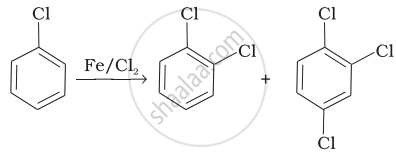 |
(a) Nucleophilic aromatic substitution |
| (ii) | \[\begin{array}{cc} \ce{CH3 - CH = CH2 + HBr -> CH3 - CH - CH3}\\ \phantom{............................}|\phantom{}\\ \phantom{.............................}\ce{Br}\phantom{} \end{array}\] |
(b) Electrophilic aromatic substitution |
| (iii) | 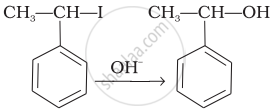 |
(c) Saytzeff elimination |
| (iv) | 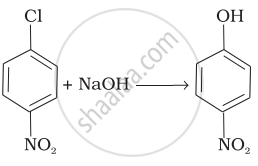 |
(d) Electrophilic addition |
| (v) | \[\begin{array}{cc} \ce{CH3 CH2 CH CH3 ->[alc.KOH] CH3 CH = CH CH3}\\ \phantom{}|\phantom{..........................}\\ \phantom{}\ce{Br}\phantom{........................} \end{array}\] |
(e) Nucleophilic substitution (SN1) |
Which of the following is the definition of chirality?
Which of the following compounds will show retention in configuration on nucleophile substitution by OH− ion?
The number of chiral carbons present in the molecule given below is ______.

In SN1 reactions, the correct order of reactivity for the following compounds:
CH3Cl, CH3CH2Cl, (CH3)2CHCl and (CH3)3CCl is ______.
Complete the reaction with the main product formed:

Explain why Grignard reagents should be prepared under anhydrous conditions.
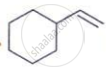 HCI, Major product ______.
