Advertisements
Advertisements
प्रश्न
Arrange the compounds of the following set in order of reactivity towards SN2 displacement:
1-Bromobutane, 1-Bromo-2, 2-dimethylpropane, 1-Bromo-2-methylbutane, 1-Bromo-3-methylbutane
Advertisements
उत्तर
The SN2 reaction involves the formation of a transition state with the carbon atom surrounded by 5 additional atoms (groups). A transition state requires minimal steric interactions. The most suitable substrates for SN2 reactions are 1° alkyl halides, followed by 2° and 3° alkyl halides. The order of reactivity towards SN2 is 1° > 2° > 3° > aryl halide. Based on this, the order will be:
\[\begin{array}{cc}
\phantom{................................................................................................}\ce{CH3}\phantom{..............................}\ce{CH3}\\
\phantom{............................................................................................}|\phantom{....................................}|\\
\ce{\underset{1-Bromobutane}{CH3(CH2)CH2Br} > \ce{\underset{1-Bromo-3-methylbutane}{(CH3)2 - CH - CH2 - CH2Br} > \ce{\underset{1-Bromo-2-methylbutane}{CH3 - CH2 - CH - CH2Br} > \ce{CH3 - C - CH2Br}}}}\\
\phantom{.................................................................................................................................}|\\
\phantom{.....................................................................................................................................}\ce{\underset{1-Bromo-2, 2-dimethylpropane}{CH3}}\
\end{array}\]
Although all alkyl halides are 1°, the order of reactivity depends on the steric barrier around the carbon bearing the –Br atom. The more bulky groups around a carbon, the lower its reactivity towards SN2.
APPEARS IN
संबंधित प्रश्न
Discuss the mechanism of alkaline hydrolysis of bromomethane.
Write the major products(s) in the following:

Write the structure of the major product in each of the following reaction :

Identify 'A' in the following reaction -

(a) 2- Bromo-2 methylbutane
(b) 1 -Bromo-2,2-dimethylpropane
(c) 1 - Bromo - 3 -methylbutane
(d) 1 - Bromo- 2 -methylpropane
AgCN reacts with haloalkanes to form isocyanide. Haloalkanes react with KCN to form alkyl cyanides as the main product. Why?
Which of the following is an example of SN2 reaction?
Halogenation of alkanes is ____________.
Which one is most reactive towards SN1 reaction?
Among the following, the dissociation constant is highest for:
How do polar solvents help in the first step in SN1 mechanism?
Cyanide ion acts as an ambident nucleophile. From which end it acts as a stronger nucleophile in aqueous medium? Give reason for your answer.
Which one is the correct order of nucleophilic strength (pKa) of following nucleophiles?
Which one of the following compounds is more reactive towards SN1 reaction?
The major product formed in the following reaction is:

Optical activity of an enantiomeric mixture is +12.6° and the specific rotation of (+) isomer is +30°. The optical purity is ______ %.
The following questions are case-based questions. Read the passage carefully and answer the questions that follow:
|
Nucleophilic Substitution: Influences of solvent polarity: The reaction rate (SN2) of 2-bromopropane and NaOH in ethanol containing 40% water is twice slower than in absolute ethanol. Hence the level of solvent polarity has an influence on both SN1 and SN2 reactions but with different results. Generally speaking, a weak polar solvent is favourable for SN2 reaction, while a strong polar solvent is favourable for SN1. Generally speaking, the substitution reaction of tertiary haloalkane is based on SN1 mechanism in solvents with a strong polarity (for example ethanol containing water). |
Answer the following questions:
(a) Why racemisation occurs in SN1? (1)
(b) Why is ethanol less polar than water? (1)
(c) Which one of, the following in each pair is more reactive towards SN2 reaction? (2)
(i) CH3 – CH2 – I or CH3CH2 – Cl
(ii)
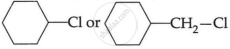
OR
(c) Arrange the following in the increasing order of their reactivity towards SN1 reactions: (2)
(i) 2-Bromo-2-methylbutane, 1-Bromo-pentane, 2-Bromo-pentane
(ii) 1-Bromo-3-methylbutane, 2-Bromo-2-methylbutane, 2-Bromo-3- methylbutane
Explain why Grignard reagents should be prepared under anhydrous conditions.
Which of the following is halogen exchange reaction?
The correct order of increasing reactivity of
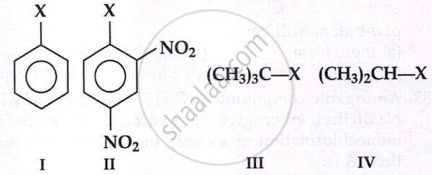
C-X bond towards nucleophile in the following compounds is:
Assertion (A):  undergoes SN2 reactions faster than
  .
.
Reason (R): Iodine is a better leaving group because of its large size.
In the light of the above statements, choose the correct answer from the options given below:
