Advertisements
Advertisements
प्रश्न
An organic compound A with the molecular formula (+) C4H9Br undergoes hydrolysis to form (+) C4H9OH. Give the structure of A and write the mechanism of the reaction.
Advertisements
उत्तर
\[\begin{array}{cc}\ce{C2H5 - CH - CH3}\\
|\phantom{.}\\\ce{Br}\end{array}\]
Mechanism:
\[\begin{array}{cc}
\ce{H}\phantom{.................}\ce{H}\\
|\phantom{..................}|\\
\ce{H3C - C - C2H5 ->[Slow step] C^⊕ + B\overset{⊖}{r}}\\
\phantom{...}|\phantom{................}/\phantom{...}\backslash\\
\phantom{.......}\ce{Br}\phantom{...........}\ce{H3C}\phantom{....}\ce{C2H5}
\end{array}\]
\[\begin{array}{cc}
\ce{H}\phantom{....................}\ce{H}\phantom{...............}\ce{H}\phantom{.......}\\
|\phantom{.....................}|\phantom{................}|\phantom{.......}\\
\ce{C^⊕ + O\overset{⊖}{H} ->[Fast] H3C - C - OH + HO - C - CH3}\\
/\phantom{..}\backslash\phantom{....................}|\phantom{.................}|\phantom{.........}\\
\ce{H3C}\phantom{...}\ce{C2H5}\phantom{...............}\ce{C2H5}\phantom{.............}\ce{C2H5}\phantom{........}
\end{array}\]
APPEARS IN
संबंधित प्रश्न
Given reasons: C–Cl bond length in chlorobenzene is shorter than C–Cl bond length in CH3–Cl.
In a coordination entity of the type [PtCl2(en)2]2+ which isomer will show optical isomerism?
An important chemical method to resolve a racemic mixture makes use of the formation of ______.
The increasing order of reactivity towards SN1 mechanism is:
(I) \[\begin{array}{cc}
\ce{CH3-CH-CH2-CH3}\\
|\phantom{........}\\
\ce{CH3}\phantom{.....}
\end{array}\]
(II) CH3CH2CH2Cl
(III) P–CH3O–C6H4–CH2Cl
Which of the following alkyl halides will undergo SN1 reaction most readily?
Write the structures and names of the compounds formed when compound ‘A’ with molecular formula, \[\ce{C7H8}\] is treated with \[\ce{Cl2}\] in the presence of \[\ce{FeCl3}\].
Elimination reactions (especially β-elimination) are as common as the nucleophilic substitution reaction in case of alkyl halides. Specify the reagents used in both cases.
In SN1 reactions, the correct order of reactivity for the following compounds:
CH3Cl, CH3CH2Cl, (CH3)2CHCl and (CH3)3CCl is ______.
Which alkyl halide from the following pair would you expect to react more rapidly by an SN2 mechanism? Explain your answer.
\[\begin{array}{cc}
\ce{CH3CHCH2CH2Br}\\
|\phantom{.............}\\
\ce{CH3}\phantom{..........}\\
\end{array}\] or \[\begin{array}{cc}
\ce{CH3CH2CHCH2Br}\\
|\\
\phantom{...}\ce{CH3}\\
\end{array}\]
The correct order of increasing reactivity of
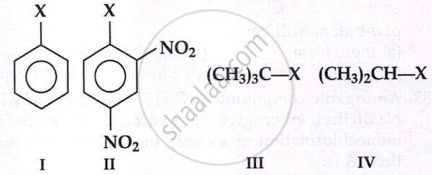
C-X bond towards nucleophile in the following compounds is:
