Advertisements
Advertisements
प्रश्न
Which of the following statements are correct about this reaction?

(i) The given reaction follows SN2 mechanism.
(ii) (b) and (d) have opposite configuration.
(iii) (b) and (d) have same configuration.
(iv) The given reaction follows SN1 mechanism.
Advertisements
उत्तर
(i) The given reaction follows SN2 mechanism.
(ii) (b) and (d) have opposite configuration.
Explanation:
In the given reaction, alkyl halide is primary in nature. Here, a transitory state is observed in which one bond is broken and one bond is formed synchronously he., in one step. So, it follows SN2 mechanism.
In this mechanism, nucleophile attacks the carbon at 180° to the leaving group. So the reactant and product have opposite configuration.
APPEARS IN
संबंधित प्रश्न
Which would undergo SN2 reaction faster in the following pair and why ?

In the following pair of halogen compounds, which compound undergoes a faster SN1 reaction?

Write the isomers of the compound having the formula C4H9Br.
Which compound in the following pair will react faster in SN2 reaction with OH−?
(CH3)3CCl or CH3Cl
Write the structure of the major organic product in the following reaction:
\[\ce{CH3CH(Br)CH2CH3 + NaOH ->[water]}\]
Arrange the compounds of the following set in order of reactivity towards SN2 displacement:
1-Bromo-3-methylbutane, 2-Bromo-2-methylbutane, 2-Bromo-3-methylbutane
Arrange the compounds of the following set in order of reactivity towards SN2 displacement:
1-Bromobutane, 1-Bromo-2, 2-dimethylpropane, 1-Bromo-2-methylbutane, 1-Bromo-3-methylbutane
How the following conversion can be carried out?
Ethyl chloride to propanoic acid.
What is the action of the following on ethyl bromide?
silver acetate
Which of the following is an example of SN2 reaction?
Halogenation of alkanes is ____________.
In the SN1 reaction, racemization takes place. It is due to:
SN2 mechanism proceeds through intervention of ____________.
Complete the following analogy:
Same molecular formula but different structures: A : : Non superimposable mirror images: B
Write the structures and names of the compounds formed when compound ‘A’ with molecular formula, \[\ce{C7H8}\] is treated with \[\ce{Cl2}\] in the presence of \[\ce{FeCl3}\].
Match the reactions given in Column I with the types of reactions given in Column II.
| Column I | Column II | |
| (i) | 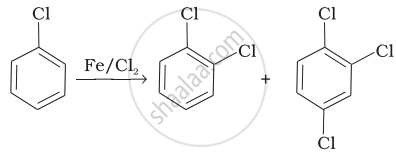 |
(a) Nucleophilic aromatic substitution |
| (ii) | \[\begin{array}{cc} \ce{CH3 - CH = CH2 + HBr -> CH3 - CH - CH3}\\ \phantom{............................}|\phantom{}\\ \phantom{.............................}\ce{Br}\phantom{} \end{array}\] |
(b) Electrophilic aromatic substitution |
| (iii) | 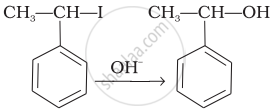 |
(c) Saytzeff elimination |
| (iv) | 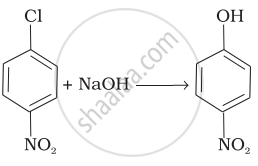 |
(d) Electrophilic addition |
| (v) | \[\begin{array}{cc} \ce{CH3 CH2 CH CH3 ->[alc.KOH] CH3 CH = CH CH3}\\ \phantom{}|\phantom{..........................}\\ \phantom{}\ce{Br}\phantom{........................} \end{array}\] |
(e) Nucleophilic substitution (SN1) |
Racemisation occurs in ______.
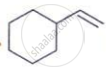 HCI, Major product ______.
Assertion (A):  undergoes SN2 reactions faster than
  .
.
Reason (R): Iodine is a better leaving group because of its large size.
In the light of the above statements, choose the correct answer from the options given below:
The compound that will undergo SN1 reaction with the fastest rate is:
