Advertisements
Advertisements
प्रश्न
In the following pair of halogen compounds, which compound undergoes a faster SN1 reaction?

Advertisements
उत्तर
The activity of halogen compounds in SN1 reaction depends on the stability of the carbocation formed due to ionization. The order of stability is tertiary > secondary > primary. Hence, 2° alkyl chloride is more active than 1° alkyl chloride. Hence, 2° alkyl chloride is more active in SN1 reaction.
The halogen which reacts faster due to the greater stability of the 2° carbocation than the 1° carbocation is:

APPEARS IN
संबंधित प्रश्न
Discuss the mechanism of alkaline hydrolysis of bromomethane.
Write the major products(s) in the following:

Write the isomers of the compound having the formula C4H9Br.
C–Cl bond length in chlorobenzene is shorter than C–Cl bond length in CH3–Cl.
What is the action of the following on ethyl bromide:
moist silver oxide
What is the action of the following on ethyl bromide?
moist silver oxide
In a coordination entity of the type [PtCl2(en)2]2+ which isomer will show optical isomerism?
Halogenation of alkanes is ____________.
The order of reactivities of the following alkyl halides for an SN2 reaction is:
Which of the following is an optically active compound?
Among the following, the dissociation constant is highest for:
Why are aryl halides less reactive towards nucleophilic substitution reactions than alkyl halides?
Which one is the correct order of nucleophilic strength (pKa) of following nucleophiles?
The major product formed in the following reaction is:

Assertion (A) : Nucleophilic substitution of iodoethane is easier than chloroethane.
Reason (R) : Bond enthalpy of C-I bond is less than that of C-Cl bond.
Inversion of configuration occurs in ______.
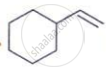 HCI, Major product ______.
The correct order of increasing reactivity of
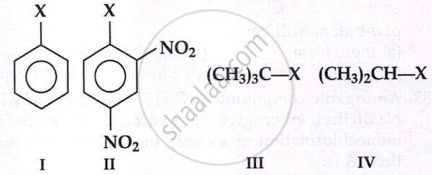
C-X bond towards nucleophile in the following compounds is:
Which of the following reactions is an example of nucleophilic substitution reaction?
Assertion (A):  undergoes SN2 reactions faster than
  .
.
Reason (R): Iodine is a better leaving group because of its large size.
In the light of the above statements, choose the correct answer from the options given below:
