Advertisements
Advertisements
प्रश्न
Write the mechanism of the following reaction:
\[\ce{{n}BuBr + KCN ->[EtOH-H2O] {n}BuCN}\]
Advertisements
उत्तर १
This reaction is a first-order nucleophilic substitution (SN1). The mechanism can be stated as:
Step 1: Generation of nucleophile:
\[\ce{KCN ->[EtOH-H2O]K+ + \overset{-}{C} ≡ N}\]
Step 2: Nucleophilic attack and formation of the transition state:
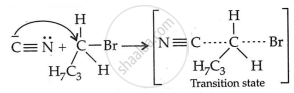
Step 3: Generation of product:
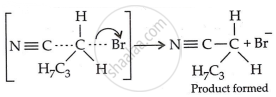
Therefore, we have
\[\ce{CH3 - CH2 - CH2 - CH2 - Br + KCN ->[EtOH/H2O]CH3CH2CH2CH2CN + KBr}\]
उत्तर २
KCN is the resonating hybrid of the following structures:
\[\ce{K^+ [^- ^{\bullet}_{\bullet}C ≡ N^{\bullet}_{\bullet} <-> ^{\bullet}_{\bullet}C = \overset{\bullet\bullet}{N}^{\bullet}_{\bullet}^-]}\]
Therefore, CN− acts as an ambident nucleophile. It can attack the carbon atom of the C–Br bond in n-BuBr through either the carbon (C) or nitrogen (N) atom. Since the C–N bond is weaker than the C–C bond, the attack occurs at the carbon atom, leading to the formation of n-butyl cyanide.
\[\ce{K^+CN^- + \underset{n-butyl bromide}{CH3CH2CH2\overset{\delta+}{C}H2 - \overset{\delta-}{B}r} -> \underset{n-butyl cyanide}{CH3CH2CH2CH2CN} + KBr}\]
APPEARS IN
संबंधित प्रश्न
How do you convert the following:
Ethanol to propanenitrile
Write the main products when methyl chloride is treated with AgCN.
Write the structures of A, B and C in the following:

In the following pair of halogen compounds, which compound undergoes a faster SN1 reaction?

Write the structure of the major organic product in the following reaction:
\[\ce{CH3CH2Br + KCN ->[aq{.} ethanol]}\]
The treatment of alkyl chlorides with aqueous KOH leads to the formation of alcohols but in the presence of alcoholic KOH, alkenes are major products. Explain.
What happens when chlorobenzene is subjected to hydrolysis?
What happens when ethyl chloride is treated with aqueous KOH?
How the following conversion can be carried out?
Ethyl chloride to propanoic acid.
SN1 reactions are accompanied by racemization in optically active alkyl halides.
The order of reactivities of the following alkyl halides for an SN2 reaction is:
The increasing order of nucleophilicity would be:
The increasing order of reactivity towards SN1 mechanism is:
(I) \[\begin{array}{cc}
\ce{CH3-CH-CH2-CH3}\\
|\phantom{........}\\
\ce{CH3}\phantom{.....}
\end{array}\]
(II) CH3CH2CH2Cl
(III) P–CH3O–C6H4–CH2Cl
Which one is the correct order of nucleophilic strength (pKa) of following nucleophiles?
In SN1 reactions, the correct order of reactivity for the following compounds:
CH3Cl, CH3CH2Cl, (CH3)2CHCl and (CH3)3CCl is ______.
The decreasing order of reactivity of the following compounds towards nucleophilic substitution (SN2) is ______.

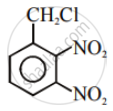

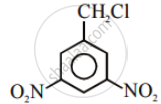
Racemisation occurs in ______.
Discuss SN2 mechanism of methyl bromide using aqueous KOH.
Which one of the following chlorohydrocarbons readily undergoes solvolysis?
