Advertisements
Advertisements
प्रश्न
Why are aryl halides less reactive towards nucleophilic substitution reactions than alkyl halides?
Why are aryl halides less reactive than alkyl halides towards nucleophilic substitution reactions?
Why are haloarenes less reactive towards nucleophilic substitution reactions as compared to haloalkanes?
Advertisements
उत्तर
Aryl halides are less reactive towards nucleophilic substitution reaction due to the following reasons.
- In haloarenes, the lone pair of electron on halogen are in resonance with benzene ring. So, C – Cl bond acquires partial double bond character which strengthen C – Cl bond and difficult to be substituted by nucleophile.
Therefore, they are less reactive towards nucleophilic substitution reaction.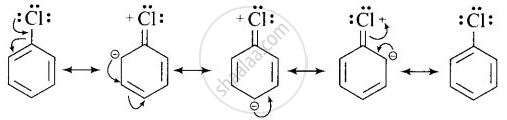
- In haloarenes, the carbon atom attached to halogen is sp2 hybridised. The sp2 hybridised carbon is more electronegative than sp3 hybridised carbon. This sp2-hybridised carbon in haloarenes can hold the electron pair of \[\ce{C - X}\] bond more tightly and make this \[\ce{C - Cl}\] bond shorter than \[\ce{C Cl}\] bond of haloalkanes.
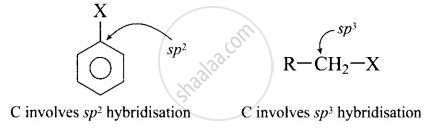
Since, it is difficult to break a shorter bond than a longer bond, therefore, halorenes are less reactive than haloalkanes. - In haloarenesm the phenyl cation is not stabilised by resonance therefore SN1 mechanism cannot be followed.
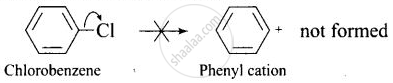
- Because of the repulsion between the nucleophile and electron-rich arenas, aryl halides are less reactive than alkyl halides.
संबंधित प्रश्न
Discuss the mechanism of alkaline hydrolysis of bromomethane.
Write the structures of A, B and C in the following:

Write the structure of the major organic product in the following reaction:
\[\ce{CH3CH(Br)CH2CH3 + NaOH ->[water]}\]
Arrange the compounds of the following set in order of reactivity towards SN2 displacement:
1-Bromobutane, 1-Bromo-2, 2-dimethylpropane, 1-Bromo-2-methylbutane, 1-Bromo-3-methylbutane
How the following conversion can be carried out?
Ethyl chloride to propanoic acid.
C–Cl bond length in chlorobenzene is shorter than C–Cl bond length in CH3–Cl.
What is the action of the following on ethyl bromide:
moist silver oxide
In a coordination entity of the type [PtCl2(en)2]2+ which isomer will show optical isomerism?
Which one is most reactive towards SN1 reaction?
The order of reactivities of the following alkyl halides for an SN2 reaction is:
2-Bromopentane is heated with potassium ethoxide in ethanol. The major product obtained is ____________.
Identify the end product (C) in the following sequence:
\[\ce{C2H5OH ->[SOCl2][Pyridine] A ->[KCN {(alc.)}] B ->[2H2O/H^+] C}\]
The correct order of increasing the reactivity of C–X bond towards nucleophile in following compounds.

(I)

(II)
(CH3)3CCl
(III)
(CH3)2CHCl
(IV)
Which of the following compound will undergo racemisation when reacts with aq. KOH?
(i)

(ii)
CH3CH2CH2Cl
(iii)
\[\begin{array}{cc}
\ce{CH3}\phantom{..}\\
|\phantom{....}\\
\ce{CH3-CH-CH2Cl}
\end{array}\]
(iv)
\[\begin{array}{cc}
\phantom{..}\ce{H}\\
\phantom{..}|\\
\ce{CH3-C-Cl}\\
\phantom{..}|\\
\phantom{.....}\ce{C2H5}
\end{array}\]
Which of the following alkyl halides will undergo SN1 reaction most readily?
Compound ‘A’ with molecular formula \[\ce{C4H9Br}\] is treated with aq. \[\ce{KOH}\] solution. The rate of this reaction depends upon the concentration of the compound ‘A’ only. When another optically active isomer ‘B’ of this compound was treated with aq. \[\ce{KOH}\] solution, the rate of reaction was found to be dependent on concentration of compound and \[\ce{KOH}\] both.
(i) Write down the structural formula of both compounds ‘A’ and ‘B’.
(ii) Out of these two compounds, which one will be converted to the product with inverted configuration.
Write the structures and names of the compounds formed when compound ‘A’ with molecular formula, \[\ce{C7H8}\] is treated with \[\ce{Cl2}\] in the presence of \[\ce{FeCl3}\].
CCl4 is insoluble in water because:-
Which one of the following compounds is more reactive towards SN1 reaction?
